
WV State Guide · Updated March 2026
Best Grass Seed for West Virginia
Top grass seeds for West Virginia lawns that handle acidic soil, shade, and mountain terrain. Expert picks for Charleston, Morgantown, Huntington, and Parkersburg.
Disclosure: This article contains affiliate links. If you buy through our links, we may earn a commission at no extra cost to you. All opinions are our own. Learn more.
West Virginia is Appalachian lawn country — a state where the terrain, the soil, and the tree canopy conspire to make lawn care a genuinely different experience than anywhere else east of the Mississippi. Almost Wild, Wonderful is the state motto, and it applies to your yard too: steep slopes that erode after every hard rain, acidic clay-shale soil that fights every grass seed you throw at it, and a hardwood forest canopy so thick that some yards get less than three hours of direct sun in midsummer. The state sits entirely in Zones 5b to 6b, with the higher elevations in the Allegheny Mountains pushing into Zone 5a territory, and cool-season grasses are the only option from Martinsburg to Bluefield. WVU Extension (run through West Virginia University in Morgantown) is the go-to resource for lawn advice calibrated to Appalachian conditions, and their soil testing lab processes thousands of samples annually from homeowners trying to figure out why their grass won't grow in soil that registers pH 4.5 to 5.5 without lime. If there's one universal truth about West Virginia lawn care, it's this: test your soil before you do anything else, because the acid problem is almost certainly worse than you think.
Tall fescue is the workhorse grass of West Virginia, and for good reason. It handles the state's variable conditions — heat in the Kanawha Valley, cold in the mountains, shade under hardwood canopy, wet clay soil on slopes — better than any other single species. Drive through any neighborhood in Charleston, Huntington, Parkersburg, or the Kanawha Valley communities and you'll see tall fescue everywhere: front yards, park strips, church lawns, highway medians. Jonathan Green Black Beauty Ultra has become a premium favorite among West Virginia homeowners who want the darkest green, finest-textured tall fescue available, and Pennington Rebels Tall Fescue offers proven performance at a more accessible price point that you'll find at Lowe's, Tractor Supply, and local garden centers across the state. Improved tall fescue varieties are a massive upgrade over the old Kentucky 31 that was the default for decades — K-31 served its purpose on roadsides and reclamation sites, but modern turf-type varieties offer dramatically better color, density, and disease resistance for residential lawns.
Kentucky bluegrass plays a supporting role in West Virginia, thriving in the sunnier, more maintained lots across the Eastern Panhandle and northern parts of the state while struggling in the deep shade and acidic soil that characterize much of the southern and central mountain region. Midnight Kentucky Bluegrass offers the best combination of shade tolerance and disease resistance among KBG varieties, and it performs well in Morgantown, Martinsburg, and the northern tier communities where soil conditions are slightly less acidic and the terrain is somewhat gentler than the rugged southern counties. KBG's self-repairing rhizomatous growth is valuable on West Virginia lawns that take a beating from heavy rain erosion and freeze-thaw cycles, as it fills in damaged areas without requiring overseeding. But KBG needs at least 5 hours of direct sun and struggles below pH 6.0, which limits its range in a state where half the residential lots are shaded by century-old oaks, maples, and hickories and the soil runs 5.0 to 5.5 without lime treatment.
West Virginia's soil is the state's defining lawn care challenge. The underlying geology is predominantly shale, sandstone, and coal-measure sedimentary rock that weathers into heavy, acidic clay — pH values of 4.5 to 5.5 are standard across most of the state, with some coal-country soils in the southern counties running even lower due to acid mine drainage influence on local groundwater. This acidity locks up phosphorus, calcium, and magnesium, producing thin, struggling grass that yellows and refuses to thicken no matter how much fertilizer you apply. The fix is lime — lots of it, applied consistently over multiple years. WVU Extension's soil testing lab will tell you exactly how many pounds of agricultural lime per 1,000 square feet your specific soil needs, and the answer is almost always more than you expect: 80 to 100 pounds per 1,000 square feet in a single application is not unusual for severely acid West Virginia clay, followed by annual maintenance liming of 40 to 50 pounds until pH stabilizes above 6.0. Adding to the soil challenge, many lots in the mountain communities are built on steep slopes with thin topsoil over shale bedrock, and erosion carries away your lime, fertilizer, and seed after every heavy rain.
The Appalachian climate gives West Virginia cool-season grasses a genuine advantage over most of the Southeast — summers are milder than the lowland South, with average July highs in the low-to-mid 80s in the valleys and mid-70s in the mountains, meaning your tall fescue and KBG don't face the brutal heat stress that kills lawns in North Carolina's Piedmont or Virginia's Tidewater. Fall and spring are long and mild, providing extended growing seasons on both ends of summer that cool-season grasses exploit beautifully. The downside is precipitation — West Virginia gets 40 to 55 inches of rain annually, which sounds generous until you realize it falls heavily on slopes that shed water rather than absorbing it, and the clay soil can only infiltrate about half an inch per hour before surface runoff begins. This means your lawn gets less effective moisture than the rainfall numbers suggest, and the constant wet-dry cycles on heavy clay create ideal conditions for soil compaction, brown patch fungus, and Pythium blight during humid summer stretches. Managing moisture — both excess and deficit — is the second-biggest challenge of West Virginia lawn care after correcting the acid soil.
Quick Picks: Our Top 3 for West Virginia
Understanding West Virginia's Lawn Climate
Appalachian mountain climate with cooler temperatures than surrounding states, high humidity, and abundant rainfall. Elevations range from 240 feet along the Ohio River to 4,863 feet at Spruce Knob, creating dramatic microclimates within short distances. Charleston and the Kanawha Valley are Zone 6b, while higher elevations in the eastern mountains drop to Zone 5a. Heavy tree cover from hardwood forests creates shade challenges on most residential lots.
Key Challenges
Best Planting Time for West Virginia
Late August through September for all cool-season grasses; spring seeding possible March through April but faces more weed competition
Our Top 3 Picks for West Virginia
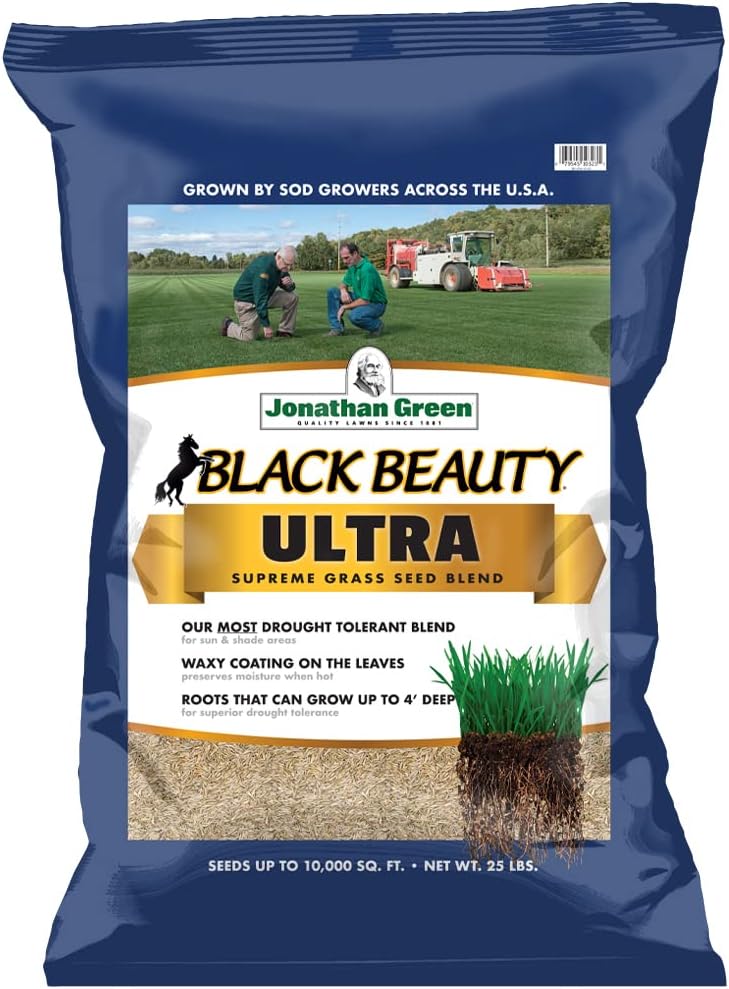
Jonathan Green Black Beauty Ultra
Jonathan Green · Cool Season · $28 (7 lbs) – $105 (25 lbs)
Why this seed for West Virginia: Black Beauty Ultra's tall fescue blend thrives in West Virginia's acidic Appalachian soil and handles the shade from hardwood forests that cover most residential lots.

Outsidepride Midnight Kentucky Bluegrass Seed
Outsidepride · Cool Season · $35 (5 lbs) – $300 (50 lbs)
Why this seed for West Virginia: For sunnier West Virginia lawns in the Kanawha Valley and Eastern Panhandle, Midnight KBG delivers the dense, dark green turf that looks exceptional against the mountain backdrop.

Pennington The Rebels Tall Fescue Mix
Pennington · Cool Season · $30-50 for 7 lbs
Why this seed for West Virginia: The Rebels blend is built for tough conditions — deep roots handle the rocky, shallow soil on West Virginia hillsides and the clay compaction common in valley developments.
Best Grass Seed by Region in West Virginia
Kanawha Valley / Charleston
The Kanawha Valley — Charleston, South Charleston, St. Albans, Nitro, Hurricane, Dunbar, and the communities lining the Kanawha River — is West Virginia's most populated region and sits in Zone 6b, the warmest zone in the state. The valley floor collects heat and humidity, pushing July highs into the upper 80s and occasionally the low 90s, while the surrounding hills create a bowl effect that traps moisture and amplifies summer disease pressure. The soil is a mix of Kanawha River alluvium on the valley floor (relatively good for lawns — silty loam that drains decently) and heavy clay-shale residuum on the surrounding hillsides (acidic, compacted, and erosion-prone). Charleston's residential neighborhoods are built on everything from flat river terraces to 30-degree slopes carved into the hillside, and slope management is a constant concern. Tall fescue is the dominant lawn grass throughout the Kanawha Valley, with Jonathan Green Black Beauty Ultra and Pennington Rebels performing well in the partial shade conditions created by the valley's dense hardwood canopy. The state capitol grounds and Kanawha Boulevard's historic homes feature some of the best-maintained lawns in West Virginia.
Top picks for this region:
- ✓Kanawha Valley clay-shale soil is typically pH 4.5 to 5.5 — apply pelletized lime at the rate recommended by your WVU Extension soil test (often 80 to 100 lbs per 1,000 sq ft initially) and follow with annual maintenance applications of 40 to 50 lbs until pH stabilizes above 6.0
- ✓The valley's heat and humidity create peak brown patch fungus conditions in July and August — water in early morning only, avoid evening irrigation, and maintain mowing height at 3.5 to 4 inches to promote air circulation through the canopy
- ✓Hillside lots in Charleston's residential neighborhoods require erosion control measures when seeding — use erosion blankets, straw crimping, or hydroseeding on slopes above 20 degrees, because bare soil after seeding will wash away in the first heavy rain
- ✓The Kanawha River floodplain neighborhoods (South Charleston, Dunbar) have better soil than the hillside communities — the alluvial silty loam drains well and responds quickly to lime and fertilizer, making lawn establishment noticeably easier on the valley floor
Morgantown / North Central
North-central West Virginia — Morgantown, Fairmont, Clarksburg, Bridgeport, and the communities of Monongalia, Marion, and Harrison counties — sits in Zone 6a to 6b on the western slope of the Allegheny Front. Morgantown's elevation (960 to 1,700 feet depending on neighborhood) brings slightly cooler summers than the Kanawha Valley, with July highs averaging the low-to-mid 80s and winters that deliver regular single-digit lows in January. West Virginia University's campus and the surrounding residential neighborhoods sit on rolling hills above the Monongahela River, with soil derived from sandstone and shale residuum — heavy clay, acidic (pH 5.0 to 5.5 typically), and often compacted by generations of construction on the steep Morgantown terrain. WVU's agricultural research programs include turfgrass studies relevant to the region, and the WVU Extension office in Monongalia County is one of the most active in the state. KBG performs well in the sunnier lots and newer subdivisions around Star City and Westover, while tall fescue dominates the shaded older neighborhoods around Sunnyside, South Park, and the hillside communities above the Mon River. The Morgantown area's cooler climate gives cool-season grasses a performance edge over the warmer valleys further south.
Top picks for this region:
- ✓Morgantown's rolling terrain means most residential lots have significant slope — establish a thick grass stand before winter freeze-thaw cycles begin, because bare slopes erode rapidly during the spring thaw when frozen subsoil prevents infiltration
- ✓WVU Extension's soil testing lab at the Morgantown campus is the most convenient resource for north-central homeowners — submit samples by August to get lime and fertilizer recommendations in time for the critical September seeding window
- ✓The newer subdivisions around Cheat Lake and Star City are built on compacted construction fill — core aerate twice annually (May and September) to break through the construction hardpan that prevents root development in these communities
- ✓North-central West Virginia's cooler summers make it the best KBG-growing region in the state — Midnight KBG performs well in full-sun lots around Bridgeport and Clarksburg where the terrain is gentler and shade is less extreme than the mountain communities
Eastern Panhandle / Martinsburg
The Eastern Panhandle — Martinsburg, Charles Town, Shepherdstown, Harpers Ferry, and the communities of Berkeley and Jefferson counties — is West Virginia's outlier region, geographically and culturally closer to the Washington D.C. suburbs than to Charleston. Sitting in the Shenandoah Valley at 400 to 600 feet elevation in Zone 6b to 7a, the Eastern Panhandle has the mildest climate in West Virginia, with warmer summers and milder winters than the mountain interior. The soil is predominantly limestone-derived clay — a stark contrast to the acidic shale soils elsewhere in the state — running pH 6.5 to 7.5 in many areas, which is practically neutral by West Virginia standards. This limestone foundation means some Eastern Panhandle homeowners face the opposite soil problem from the rest of the state: soil that's already neutral or slightly alkaline and doesn't need lime at all. The region has experienced rapid suburban growth from the D.C. commuter population, with new subdivisions pushing into former farmland around Inwood, Kearneysville, and Ranson. Both KBG and tall fescue thrive in the Eastern Panhandle, and the region's lawns look more like northern Virginia's Piedmont than typical West Virginia yards.
Top picks for this region:
- ✓Eastern Panhandle limestone soil is often pH 6.5 to 7.5 — do NOT apply lime without a WVU Extension soil test first, as over-liming neutral soil causes nutrient lockout and is the opposite of what the rest of West Virginia needs
- ✓The Shenandoah Valley location brings warmer summers than the mountain interior — June through August heat can push KBG into stress dormancy in full-sun lots; tall fescue handles the Eastern Panhandle's warmth better as a primary lawn grass
- ✓New construction in Martinsburg, Inwood, and Ranson is built on compacted former farmland — these sites need aggressive core aeration for the first three to five years to restore soil structure destroyed by heavy equipment during development
- ✓The Eastern Panhandle receives less rainfall (35 inches) than the mountain interior (45 to 55 inches) — irrigation or drought-tolerant tall fescue varieties are more important here than in the wetter regions of the state
Southern West Virginia / Beckley-Bluefield
Southern West Virginia — Beckley, Bluefield, Princeton, Hinton, and the communities scattered through Raleigh, Mercer, Fayette, and Summers counties — is the Appalachian mountain heart of the state. Elevations range from 1,500 feet in the river valleys to 3,000-plus feet on the ridgetops, placing the region in Zone 5b to 6a with cold winters (single digits to minus 10 in exposed locations), cool summers (July highs in the upper 70s to low 80s), and the highest rainfall in the state at 45 to 55 inches annually. The soil is derived from coal-measure sandstone and shale, producing some of the most acidic residential soil in the eastern United States — pH 4.0 to 5.0 is not uncommon, especially in communities near historic coal mining operations where acid mine drainage has further acidified the groundwater and surface soil. Steep terrain is the defining physical feature: many residential lots in Beckley, Bluefield, and the coal-town communities sit on slopes that would be considered unbuildable in flatter states. Tall fescue is the only practical lawn grass for most of southern West Virginia, as the combination of acid soil, steep slopes, heavy shade from oak-hickory-maple forest, and thin topsoil over shale eliminates most other options.
Top picks for this region:
- ✓Southern West Virginia soil is among the most acidic residential soil in the eastern U.S. — pH 4.0 to 5.0 is common, and correcting this requires heavy liming (100-plus lbs per 1,000 sq ft initially) with annual follow-up based on WVU Extension soil test results
- ✓Steep slopes are the norm in Beckley and Bluefield — use tall fescue's deep root system and erosion blankets to stabilize slopes, and consider terracing severely steep areas rather than trying to maintain grass on a 30-degree grade
- ✓The cool mountain climate is an advantage for tall fescue — summer highs in the upper 70s mean fescue doesn't face the heat stress it would in the lowland South, and the extended cool seasons on both ends of summer provide ideal growing conditions
- ✓Coal-country communities near historic mining operations may have soil affected by acid mine drainage — if your soil tests below pH 4.5 despite liming, have WVU Extension evaluate for heavy metal contamination from mining residue before investing heavily in lawn establishment
West Virginia Lawn Care Calendar
Spring
March - May
- •Apply pre-emergent herbicide when soil temperatures reach 55 degrees at 4-inch depth — in the Kanawha Valley and Eastern Panhandle that's typically mid-to-late March, in Morgantown early April, in the mountain communities mid-to-late April
- •Submit a soil test through WVU Extension's Soil Testing Laboratory — this is the most important single step for any West Virginia lawn because the acid soil problem affects virtually every county and the correction rate varies dramatically by location
- •Apply pelletized lime based on soil test results — most West Virginia soil needs significant liming (60 to 100 lbs per 1,000 sq ft), and spring is an excellent time to apply because spring rains help move the lime into the soil profile
- •Begin mowing tall fescue at 3 to 3.5 inches once spring growth resumes — do not scalp cool-season lawns, as the leaf blade area is critical for photosynthesis during the prime spring growing period
- •Seed bare spots and thin areas in mid-to-late April through May — use erosion blankets on slopes above 15 degrees, as spring rain will wash bare seed off West Virginia's characteristic steep terrain
- •Core aerate compacted clay soils in late April to early May — West Virginia's clay-shale soil compacts severely under foot traffic and rain impact, and spring aeration before the growing season allows roots to exploit the opened channels
Summer
June - August
- •Raise mowing height to 3.5 to 4 inches for tall fescue and 3 inches for KBG during summer — taller grass shades the soil, reduces moisture loss, and helps cool-season grasses survive the July-August heat that's mildest in the mountains but genuine in the Kanawha and Ohio River valleys
- •Water 1 to 1.25 inches per week if rainfall doesn't provide it — West Virginia gets plenty of annual rain, but July and August can bring two-to-three-week dry stretches that stress cool-season grasses, particularly in the drier Eastern Panhandle
- •Monitor for brown patch fungus in the humid Kanawha Valley and river bottom communities — circular brown patches 6 to 24 inches across with dark brown borders appear during hot humid periods; avoid evening watering and reduce nitrogen to slow the disease
- •Sharpen mower blades monthly — West Virginia's humidity makes dull-cut grass particularly susceptible to disease, as ragged wound sites stay moist and invite fungal infection
- •Do not apply nitrogen fertilizer from mid-June through August — summer nitrogen stresses heat-affected cool-season grass and promotes the rapid, soft growth that's most vulnerable to brown patch and dollar spot
- •Scout for Japanese beetle grubs in late July — West Virginia's hardwood forests support large Japanese beetle populations, and their grubs feed on grass roots in late summer; treat if counts exceed 8 grubs per square foot
Fall
September - November
- •Core aerate and overseed from September 1 through October 1 — this is the optimal window for West Virginia lawn improvement, when soil temps are warm enough for germination and the long mild fall provides weeks of ideal growing conditions for new seedlings
- •Apply fall fertilizer (1 lb nitrogen per 1,000 sq ft) in mid-September to support root growth, disease recovery, and carbohydrate storage for winter — fall fertilization is the single most impactful fertility application for West Virginia lawns
- •Apply additional lime in October if your WVU soil test indicates pH is still below 6.0 — fall liming gives the lime all winter to react with the soil before the spring growing season begins
- •Apply winterizer fertilizer with high potassium (such as 5-5-25) in late October to harden grass before winter — potassium strengthens cell walls and improves freeze tolerance for the mountain communities that regularly see single-digit lows
- •Continue mowing at normal height until growth stops — do not scalp before dormancy, as the leaf blade insulates the crown from freeze damage and protects against the erosion that bare soil invites on West Virginia's steep slopes
- •Rake and remove fallen hardwood leaves before they mat down and smother the grass — West Virginia's dense canopy drops an enormous leaf load that will kill grass underneath if left through winter
Winter
December - February
- •Leave dormant grass alone — West Virginia cool-season grasses go semi-dormant in winter but maintain some green color in the milder valleys; no fertilizer, minimal traffic, and no herbicide applications until spring
- •Address erosion damage from winter rain and snowmelt on exposed slopes — lay straw or erosion blankets over bare areas to prevent further soil loss before spring seeding
- •Plan lime applications: review your WVU Extension soil test and order pelletized lime in bulk before spring — lime is cheap but the correction process takes years on severely acid West Virginia soil, and consistent annual applications are the only path to viable pH
- •Service your mower and tune up any hillside-specific equipment (string trimmers for steep banks, walk-behind mowers for slopes too steep for riding mowers) — West Virginia terrain demands equipment that flatland homeowners never need
- •Order grass seed by February from local sources — Jonathan Green Black Beauty Ultra and Pennington Rebels sell out at regional garden centers, Tractor Supply, and Southern States stores as spring approaches
West Virginia Lawn Tips You Won't Find on the Seed Bag
WVU Extension Soil Testing Is Step One — Always
The West Virginia University Extension Service operates a soil testing laboratory on the Morgantown campus that processes samples from all 55 counties, and submitting a soil test is the single most important thing any West Virginia homeowner can do before spending money on seed, fertilizer, or lawn treatments. The test costs about $12 per sample and returns results with lime and fertilizer recommendations calibrated specifically to West Virginia's acidic soils — not the generic national advice you'd get from a bag of fertilizer at Home Depot. Almost every West Virginia soil test comes back with a lime recommendation, and the amount needed is often shockingly high: 80 to 100 pounds of pelletized lime per 1,000 square feet is a common initial recommendation for untreated soil. Without lime, your fertilizer is largely wasted because low pH locks up the nutrients before roots can absorb them. Get the soil test. Follow the lime recommendation. Everything else flows from there.
Acidic Soil Is the Great Equalizer in West Virginia
West Virginia's shale and sandstone geology produces soil that's naturally acidic, and the coal-measure formations underlying much of the southern and central part of the state make it even worse. pH values of 4.5 to 5.5 are standard across most residential lots, and in coal country near Beckley, Bluefield, and the southern counties, values below 4.5 aren't unusual. At these pH levels, phosphorus is locked up by aluminum and iron, calcium and magnesium are depleted, and beneficial soil microbes that decompose thatch and cycle nutrients can't function. Your grass struggles not because you're doing anything wrong, but because the soil chemistry is hostile to plant life. Lime is the fix, but it's not a one-time application — it takes years of consistent liming to move severely acidic soil into the 6.0 to 6.5 range where cool-season grasses thrive. Pelletized lime reacts faster than agricultural ground lime and is easier to apply with a broadcast spreader. Plan on annual liming every fall for at least three to five years, guided by annual WVU soil tests, before declaring the pH problem solved.
Steep Slopes Require Different Lawn Strategies
West Virginia's terrain means that a significant percentage of residential lots have slopes exceeding 15 degrees, and many mountain-community yards include sections approaching 30 degrees or steeper. On these slopes, standard lawn establishment practices fail: broadcast seed washes away in the first rain, fertilizer runs off before it can be absorbed, and even established grass thins over time as gravity and water move soil downhill. For slopes above 15 degrees, use erosion control blankets staked firmly into the hillside, or invest in hydroseeding (a slurry of seed, fertilizer, mulch, and tackifier sprayed onto the slope). Tall fescue's deep root system (3 to 4 feet in West Virginia clay) makes it the best grass choice for slope stabilization. On the steepest sections, consider whether grass is even the right answer — native ground covers, retaining walls, and terracing may be more effective than fighting gravity every season. WVU Extension has published guides on slope management specific to Appalachian terrain that address these challenges directly.
Shade Is Everywhere — Choose Grass Accordingly
West Virginia's hardwood forests — oak, hickory, maple, tulip poplar, beech — create a canopy over residential lots that ranges from moderate to impenetrable. In the mountain communities and the established neighborhoods of Charleston, Huntington, and Morgantown, many yards receive less than 4 hours of direct sunlight at peak summer, and some deeply wooded lots get barely 2. This shade level is below the minimum for Kentucky bluegrass (which needs 5-plus hours), challenging for standard tall fescue (which needs 4-plus hours), and at the extreme limit even for shade-tolerant varieties. Jonathan Green Black Beauty Ultra is one of the most shade-tolerant tall fescue blends available, incorporating endophyte-enhanced varieties that perform well at 3 to 4 hours of filtered light. For the deepest shade, consider whether a lawn is realistic — ground covers like pachysandra, vinca, or native woodland plants may serve the space better than a struggling, thin stand of grass that requires constant overseeding to maintain coverage.
Fall Is the Season That Matters Most in West Virginia
West Virginia's long, mild fall — September through November typically delivers ideal cool-season grass growing temperatures with reliable rainfall — is your single best window for lawn improvement. The September 1 through October 1 overseeding window aligns perfectly with declining summer heat, warm soil temperatures for germination, reduced weed competition as summer annuals die off, and the onset of fall rains that keep new seedlings moist. A West Virginia homeowner who core aerates, limes, overseeds with improved tall fescue, and fertilizes in September will see dramatically better results than someone who tries to do the same work in spring, when weed competition is fierce and the clock is ticking toward summer heat stress. Fall-seeded grass establishes deep roots through the long autumn and early winter, entering its first summer with a mature root system that's far more drought- and heat-tolerant than spring-seeded grass trying to survive July on three months of root development.
Leaf Management Is a Bigger Job Than You Think
West Virginia's dense hardwood canopy drops an enormous volume of leaves every fall — far more than most homeowners in non-forested states ever deal with. If those leaves are left on the lawn through winter, they mat down, block sunlight and air circulation, trap moisture against the grass surface, and create ideal conditions for snow mold and other fungal diseases that kill grass beneath the leaf layer. Mulching leaves with a mulching mower is effective up to a point — when you can still see grass through the mulched layer, you're fine. When the leaves are thick enough to completely cover the grass, you need to remove them by raking, blowing, or bagging. The good news: mulched hardwood leaves are an excellent source of organic matter for West Virginia's depleted clay soils. Run them over with the mulching mower and let them decompose into the soil profile, or compost them and topdress in spring. The organic matter helps loosen clay, improve drainage, and buffer the acidic soil chemistry.
What West Virginia Lawn Pros Actually Plant
Tall Fescue
Most PopularTall fescue is West Virginia's dominant lawn grass by a wide margin, and improved turf-type varieties have transformed what was once considered a coarse, low-grade grass into a premium residential option. Jonathan Green Black Beauty Ultra is the prestige choice, with its dark green color, fine texture, and excellent shade tolerance that suits West Virginia's heavily wooded lots. Pennington Rebels Tall Fescue is the value alternative, widely available at Lowe's, Tractor Supply, and Southern States stores throughout the state and offering reliable performance at a lower price point. Tall fescue handles everything West Virginia throws at it: acidic clay soil (once limed to acceptable pH), steep slopes (its 3 to 4-foot root system anchors it), partial shade (3 to 4 hours of filtered light is sufficient for good varieties), and the wet-humid summers that promote disease in less resistant species. Its bunch-type growth means periodic overseeding every two to three years to maintain density, but this is a small price for a grass that survives conditions that would eliminate bluegrass.
Kentucky Bluegrass
Very PopularKentucky bluegrass fills the premium, full-sun niche in West Virginia — performing beautifully in the sunnier lots of the Eastern Panhandle around Martinsburg and Charles Town, in the newer open-plan subdivisions near Bridgeport and Clarksburg, and in any yard that receives 5-plus hours of direct sun. Midnight Kentucky Bluegrass is the recommended variety for West Virginia, offering darker color and better shade tolerance than common KBG, though even Midnight needs more sun than tall fescue to maintain density. KBG's self-repairing rhizomatous growth is its biggest advantage over tall fescue — bare spots fill in naturally rather than requiring overseeding, which is valuable on West Virginia lots where erosion damage creates constant thin spots. The limitations in West Virginia are shade tolerance (KBG thins rapidly below 5 hours of sun) and pH sensitivity (KBG performs poorly below 6.0, demanding consistent liming on West Virginia's acid soils). For the right site — sunny, limed, and not too steep — KBG delivers the classic dense lawn that tall fescue can't quite match.
Perennial Ryegrass (in Blends)
PopularPerennial ryegrass is used extensively in West Virginia as a blend component rather than a standalone lawn grass. Mixed at 20 to 30 percent with tall fescue or KBG, ryegrass provides rapid germination (5 to 7 days versus 14 to 21 for fescue) that gives quick ground cover on erosion-prone slopes while the slower-establishing fescue fills in underneath. This blend strategy is particularly valuable in West Virginia where bare soil on a slope means erosion damage with the next rainstorm, and waiting three weeks for tall fescue to germinate can result in significant soil loss. Professional lawn installers and hydroseeding companies across the state routinely include ryegrass in their mixes for this quick-cover benefit. Ryegrass also provides excellent wear tolerance for high-traffic areas and establishes well in the cool fall temperatures when most West Virginia overseeding is done.
Fine Fescue (Deep Shade)
Niche ChoiceFine fescue species — creeping red fescue, chewings fescue, and hard fescue — serve as the deep shade solution for West Virginia yards where even shade-tolerant tall fescue struggles. Under the dense canopy of mature oaks, maples, and hickories that characterize old-growth neighborhoods in Charleston, Morgantown, and Huntington, fine fescues maintain coverage at light levels as low as 2 to 3 hours of filtered sun. They need less fertilizer and water than tall fescue or KBG, tolerate the acidic soil slightly better than bluegrass, and produce a soft, fine-textured turf that blends naturally with the woodland setting. Fine fescues are not wear-tolerant and will thin under foot traffic, making them best suited for side yards, under-tree areas, and low-traffic zones. As a component of a shade mix combined with shade-tolerant tall fescue, fine fescue extends the viable range of grass into West Virginia's darkest lot conditions.
Kentucky 31 Tall Fescue (Legacy/Utility)
Niche ChoiceKentucky 31 tall fescue remains a presence in West Virginia, though its role has shifted from primary lawn grass to utility and reclamation use. K-31 is the grass you see on highway medians, mine reclamation sites, rural road banks, and large rural lots where the goal is functional ground cover rather than residential aesthetics. It's cheap (roughly half the cost of turf-type tall fescue per pound), incredibly tough, and establishes on the worst soil West Virginia has to offer — including the acid mine drainage sites in the southern coal counties where almost nothing else survives. For residential lawns, K-31 has been largely replaced by turf-type varieties like Black Beauty Ultra and Rebels that offer dramatically better color, density, and texture. But on a 5-acre rural lot in Raleigh County where the goal is erosion control and something green to mow, K-31 is still the honest, practical answer.
West Virginia Lawn Seeding Tips
Getting the best results from your grass seed in West Virginia comes down to timing, soil prep, and choosing the right variety for your specific conditions. Here are our top tips:
- Test your soil first. A $15 soil test from your West Virginia extension office tells you exact pH and nutrient levels. Most cool-season grasses prefer pH 6.0-7.0.
- Prep the seedbed properly. Rake or aerate to ensure good seed-to-soil contact. This single step improves germination rates more than any seed coating or starter fertilizer.
- Use a starter fertilizer. Apply a phosphorus-rich starter fertilizer at seeding time to promote root development. We recommend Scotts Starter Fertilizer or The Andersons Starter.
- Water correctly. Keep the seedbed consistently moist (not soaked) for the first 2-4 weeks. Light watering 2-3 times per day is better than one heavy soaking.
- Be patient. Kentucky Bluegrass takes 14-28 days to germinate. Tall Fescue is faster at 7-14 days. Don't panic if you don't see results immediately.
- Consider pre-germinating KBG. If you're planting Kentucky Bluegrass, you can cut germination time from 30 days to under a week using the bucket-and-bubble pre-germination method. This is especially valuable for late-season seeding in West Virginia.
Frequently Asked Questions
When is the best time to plant grass seed in West Virginia?
Late August through September for all cool-season grasses; spring seeding possible March through April but faces more weed competition
What type of grass grows best in West Virginia?
West Virginia is best suited for cool-season grasses like Kentucky Bluegrass, Tall Fescue, and Perennial Ryegrass. These grasses thrive in spring and fall, stay green longer into winter, and handle cold temperatures well.
What are the biggest lawn care challenges in West Virginia?
The main challenges for West Virginia lawns include extremely acidic soil (ph 4.5-5.5), steep terrain makes mowing difficult, heavy shade from appalachian hardwood canopy, rocky, shallow topsoil on hillsides. Choosing the right grass variety that is adapted to these specific conditions is the single most important decision you can make for your lawn.
Can I grow Kentucky Bluegrass in West Virginia?
Absolutely — Kentucky Bluegrass is one of the best choices for West Virginia. It thrives in the cool-season climate, produces a beautiful dense lawn, and self-repairs through rhizome spread. Midnight KBG is our top pick for the darkest, most premium-looking lawn.
How much does it cost to seed a lawn in West Virginia?
For a typical 5,000 sq ft lawn, expect to spend $150-$400 on seed alone depending on the variety. Premium seeds like Midnight Kentucky Bluegrass or Zenith Zoysia cost more per pound but deliver better results. Add $50-$100 for starter fertilizer and $20-$50 for soil amendments. The seed is the smallest part of your total investment — proper soil prep and consistent watering matter more than saving $50 on cheaper seed.
More Lawn Care Resources
Not in West Virginia?
We have state-specific grass seed guides for all 50 states.