
NE State Guide · Updated March 2026
Best Grass Seed for Nebraska
Top grass seeds for Nebraska lawns that handle prairie wind and extreme temperatures. Expert picks for Omaha, Lincoln, Grand Island, and the Sandhills.
Disclosure: This article contains affiliate links. If you buy through our links, we may earn a commission at no extra cost to you. All opinions are our own. Learn more.
Nebraska is lawn country in the purest, most unpretentious sense. From Omaha's manicured suburban subdivisions to the ranch yards dotting the Sandhills, Nebraskans take their grass seriously without making a religion of it — you mow it, you fertilize it, you enjoy it, and you don't lose sleep over whether your neighbor's lawn is greener than yours. The state sits squarely in Zones 4 to 5, with cool-season grasses dominating from the Missouri River bluffs to the Panhandle, and the University of Nebraska-Lincoln's turfgrass program is one of the best in the country. UNL's research at the John Seaton Anderson Turfgrass Research Facility near Mead has tested hundreds of grass varieties under actual Nebraska conditions — the brutal winter cold, the scorching summer heat, the wind that never stops, and the clay-to-sand soil gradient that runs from east to west across the state. When UNL publishes a variety recommendation, it carries weight because it was tested in the same conditions where you'll be growing it. The Nebraska Extension offices in Douglas, Lancaster, and Scotts Bluff counties are staffed by turfgrass specialists who understand the state's unique challenges, and their advice is free.
Kentucky bluegrass is king in Nebraska, and has been for generations. Drive through any established neighborhood in Omaha — Dundee, Aksarben, Benson, Millard, Papillion — and you'll see miles of dense, dark green KBG that looks like it belongs on a postcard. The state's climate is actually well-suited for bluegrass: cold winters provide the dormancy period KBG needs, spring and fall deliver the cool temperatures it thrives in, and 25 to 30 inches of annual rainfall in the eastern third of the state provides a reasonable moisture base. Improved varieties like Midnight Kentucky Bluegrass offer dramatically better heat tolerance, disease resistance, and color than the common KBG that was standard twenty years ago, and they've extended bluegrass's reliable range westward into the drier central part of the state. The one vulnerability is summer — Nebraska summers are legitimately brutal, with July and August delivering 95 to 100-degree heat combined with humidity that builds off the Missouri River and flows up the Platte Valley. KBG goes dormant during extended heat and drought stress, turning brown and alarming homeowners who are used to green lawns, but it recovers reliably when temperatures moderate in September.
Tall fescue has carved out a significant and growing niche in Nebraska, particularly for homeowners who want a tougher, more drought-tolerant lawn than KBG can provide without irrigation. Combat Extreme and similar improved tall fescue blends are increasingly popular across the Omaha metro and Lincoln because they root deeper than bluegrass (3 to 4 feet versus 2 to 3 feet in Nebraska's clay-loam soil), maintain green color longer into summer drought, and tolerate the heat-humidity combination that stresses KBG in July and August. Tall fescue's bunch-type growth habit means it doesn't self-repair like rhizomatous KBG, so overseeding every few years is part of the maintenance program, but the trade-off is a lawn that shrugs off the two-week dry stretches that turn bluegrass lawns brown and crispy. UNL's turfgrass program has been evaluating tall fescue cultivars extensively and recommending them as a primary lawn grass for south-central and western Nebraska where rainfall drops below 25 inches and irrigation isn't available.
Buffalo grass holds a special place in Nebraska — it's the state's native grass, the same species that covered the Great Plains before European settlement, and it's experiencing a genuine renaissance as homeowners discover that improved varieties like Sharp's Improved produce a respectable lawn that survives on natural rainfall alone across most of the state. UNL has been at the forefront of buffalo grass breeding and research, and their turf-type buffalo grass varieties are specifically developed for lawn use rather than rangeland. Buffalo grass needs just 10 to 15 inches of water annually, which means it can survive without supplemental irrigation in Omaha (30 inches of rain), Lincoln (28 inches), and everywhere west. It goes dormant earlier and greens up later than cool-season grasses — typically brown from mid-October through mid-May in eastern Nebraska — and its appearance is different from the traditional KBG lawn: shorter, finer-textured, blue-green in color, and slightly more open in growth habit. For large lots, acreage, park strips, and homeowners who simply don't want to water, buffalo grass is the native Nebraska answer.
The defining challenge of Nebraska lawn care is the extreme temperature swing — this state sees minus 20 in January and 105 in July, a 125-degree range that tests any grass species to its absolute limits. Add persistent wind that increases evapotranspiration rates by 20 to 30 percent compared to sheltered regions, hail events that can strip grass bare in minutes during severe storm season, and the east-to-west precipitation gradient that drops from 30 inches in Omaha to 15 inches in Scottsbluff, and you understand why grass variety selection in Nebraska is not a casual decision. What thrives in Bellevue may struggle in Grand Island and fail in Chadron. UNL Extension's county-by-county climate data and their turfgrass variety trial results published annually from the Mead research facility are the best resources for matching your specific Nebraska location to the right grass. The Husker spirit of self-reliance extends to lawn care — Nebraskans figure out what works for their dirt, their climate, and their water situation, and they don't need a lawn service company from out of state telling them how to grow grass on the Great Plains.
Quick Picks: Our Top 3 for Nebraska
Understanding Nebraska's Lawn Climate
Continental with extreme temperature swings — summers push past 100F in western Nebraska while winters regularly hit -20F. Omaha and Lincoln in the east get 30 inches of annual rainfall, but the Panhandle and Sandhills receive less than 17. The state sits on some of the richest prairie soil on earth in the east, transitioning to sandy Sandhills and semi-arid rangeland in the west. Wind is constant and relentless, drying out turf and increasing water demand across the state.
Key Challenges
Best Planting Time for Nebraska
Late August through mid-September for cool-season grasses; late May through June for buffalo grass after soil warms
Our Top 3 Picks for Nebraska
Outsidepride Combat Extreme Northern Zone
Outsidepride · Cool Season · $25-35 for 5 lbs
Why this seed for Nebraska: Combat Extreme's blend of cold-hardy KBG, fescue, and ryegrass handles Nebraska's -20F winters and 100F summers. The mix gives you redundancy — when one species struggles, another picks up.
Outsidepride Midnight Kentucky Bluegrass Seed
Outsidepride · Cool Season · $35 (5 lbs) – $300 (50 lbs)
Why this seed for Nebraska: KBG is king in Nebraska, and Midnight is the premium variety. UNL turfgrass researchers consistently rank it among the top performers for color, density, and cold tolerance on prairie soil.
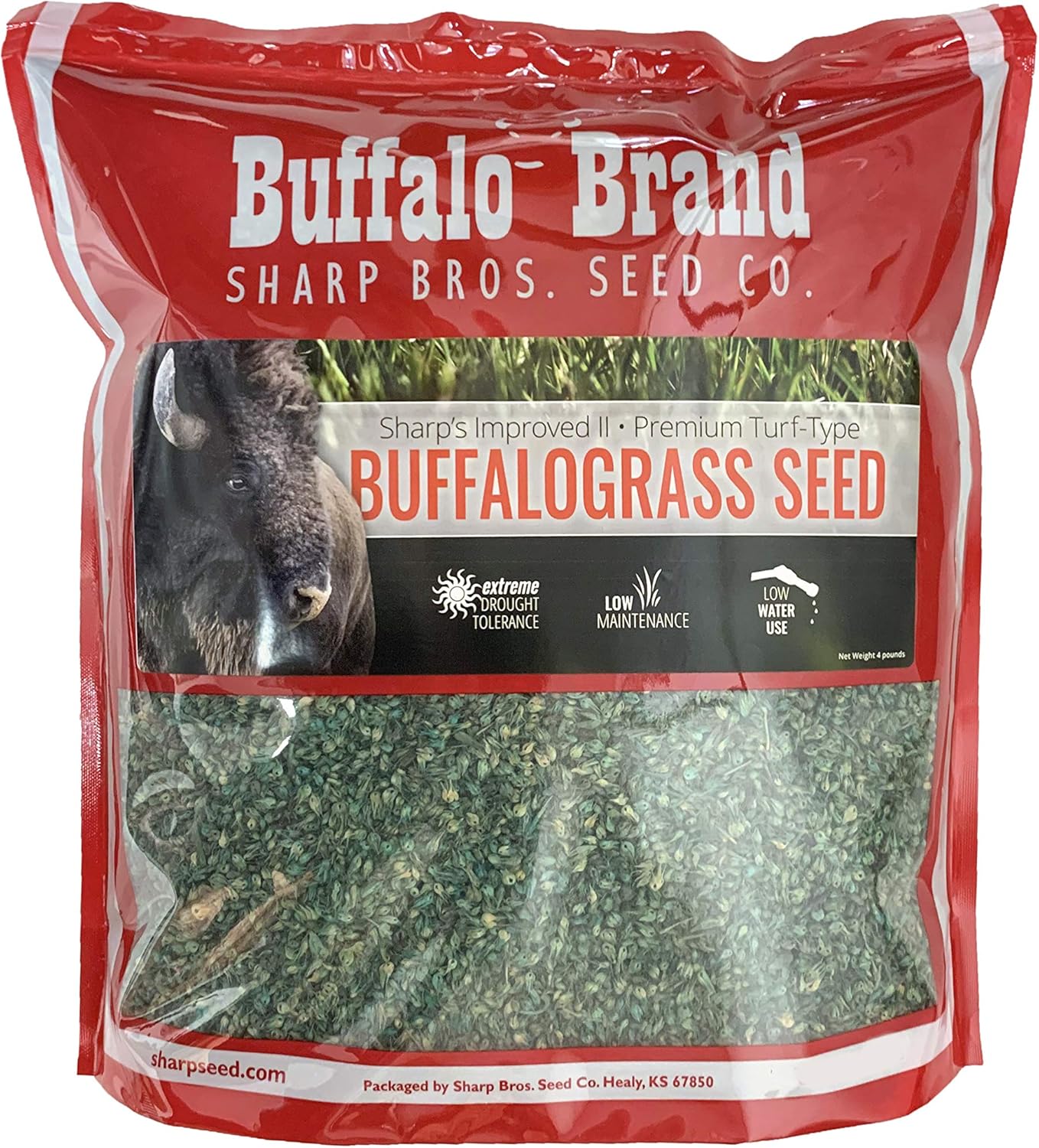
Sharp's Improved II Buffalo Grass
Sharp Bros. Seed Co. · Warm Season · $24 (3 lbs)
Why this seed for Nebraska: For western Nebraska where rainfall drops below 18 inches, buffalo grass is the honest answer. Native to the Great Plains, it thrives on neglect and survives drought that kills everything else.
Best Grass Seed by Region in Nebraska
Omaha Metro / Eastern Nebraska
The Omaha metro area — Omaha, Bellevue, Papillion, La Vista, Gretna, Elkhorn, Council Bluffs across the river — sits along the Missouri River bluffs in Zone 5b, the warmest and wettest part of Nebraska. Annual rainfall averages 30 inches, the growing season runs from mid-April through mid-October, and the soil is predominantly silty clay loam deposited by the Missouri River and loess (wind-blown silt) that blankets the eastern Nebraska hills. This soil is fertile, holds moisture well, and is generally excellent for grass — the main issue is compaction in newer subdivisions where construction equipment has compressed the clay subsoil into a near-impermeable layer. Omaha's established neighborhoods — Dundee, Benson, Aksarben, Happy Hollow — feature some of the best Kentucky bluegrass lawns in the Midwest, maintained by generations of homeowners who understand the rhythm of the season. Newer suburbs pushing west into Sarpy and Douglas counties (Gretna, Papillion, Elkhorn) are built on former farmland with good soil but heavy construction compaction that takes years of aeration to remediate.
Top picks for this region:
- ✓Missouri River bluff soil in Omaha is silty clay loam that compacts severely under construction — core aerate annually in September for the first five years on any lot built within the last decade to break through the construction hardpan
- ✓Omaha's humidity combined with summer heat creates ideal conditions for brown patch fungus in KBG lawns — water in early morning only, avoid evening irrigation that leaves blades wet overnight, and keep nitrogen moderate through summer
- ✓Crabgrass pressure is heavy in eastern Nebraska — apply pre-emergent when soil temps reach 55 degrees, which aligns with forsythia bloom in the Omaha area, typically mid-to-late April
- ✓The Missouri River valley neighborhoods (Bellevue, south Omaha) sit in a heat sink 5 to 8 degrees warmer than the western suburbs — these areas benefit from the improved heat tolerance of Midnight KBG or tall fescue blends over common bluegrass
Lincoln / Southeast Nebraska
Lincoln and the southeast Nebraska communities — Lincoln, Beatrice, Nebraska City, Falls City, and the smaller towns dotting Lancaster, Gage, and Otoe counties — sit in Zone 5a to 5b on the eastern edge of the Great Plains. Annual rainfall averages 28 inches, the soil is deep loess (wind-blown silt) over glacial till, and the terrain transitions from the rolling hills of the Missouri River watershed to the flatter plains stretching west. Lincoln's soil is generally excellent for lawns — fertile, well-structured loam that drains well and holds nutrients — though new development on the city's north and south edges encounters heavier clay subsoil that requires more aeration. The University of Nebraska-Lincoln campus is here, and the turfgrass program's influence is felt directly in the community — many local lawn care companies are staffed by UNL turfgrass management graduates, and the Extension office in Lancaster County handles more residential lawn questions than any other county in the state. KBG is the dominant lawn grass, with tall fescue gaining ground as a lower-maintenance alternative for homeowners tired of babysitting bluegrass through August heat stress.
Top picks for this region:
- ✓Lincoln's loess soil is among the best lawn-growing dirt in the Midwest — it holds moisture without waterlogging and provides excellent seed-to-soil contact, making fall overseeding particularly effective from September 1 through October 1
- ✓UNL's turfgrass program at the Mead research facility publishes annual variety trial results — Lincoln homeowners should consult these before choosing seed, as they test under the exact climate conditions you'll be growing in
- ✓Southeast Nebraska's summer heat and humidity create peak disease pressure in July and August — dollar spot and brown patch are the primary culprits in KBG lawns; maintain sharp mower blades and avoid evening watering
- ✓Buffalo grass is an excellent choice for Lincoln park strips and low-traffic areas — Sharp's Improved produces an attractive native turf that survives on Lincoln's natural 28 inches of rainfall without supplemental irrigation
Western Nebraska / Panhandle-Sandhills
Western Nebraska — Scottsbluff, Gering, Alliance, Chadron, Valentine, and the vast Sandhills region — is a different world from the Omaha-Lincoln corridor. Zone 4a to 4b conditions bring winter lows of minus 20 to minus 30 degrees, annual precipitation drops to 15 to 18 inches, and the growing season compresses to mid-May through mid-September. The Panhandle's soil is alkaline clay and gravelly loam (pH 7.5 to 8.0 in many areas), a sharp contrast to eastern Nebraska's neutral-pH loess. The Sandhills — the largest sand dune formation in the Western Hemisphere — cover north-central Nebraska with sandy soil that drains instantly and holds almost no nutrients or moisture. Wind is relentless across western Nebraska, increasing evapotranspiration and making every inch of rainfall less effective. This is native buffalo grass territory — the species evolved here, and improved varieties are the most logical lawn choice for the region. KBG is viable with irrigation in the Panhandle towns but demands more water than the climate naturally provides. Scottsbluff and the communities along the North Platte River have irrigation water available from the river system, making conventional lawn care possible in an otherwise arid landscape.
Top picks for this region:
- ✓Buffalo grass is the native and logical lawn choice for western Nebraska — Sharp's Improved survives on the 15 to 18 inches of natural precipitation the Panhandle receives, producing a functional lawn without any supplemental irrigation
- ✓Western Nebraska's alkaline soil (pH 7.5 to 8.0) can cause iron chlorosis in KBG and tall fescue — apply chelated iron (EDDHA formulation) monthly during the growing season if you see yellowing with green veins
- ✓The Sandhills' sandy soil drains so fast that nutrients leach through almost immediately — use slow-release fertilizers exclusively and apply in light, frequent doses rather than heavy seasonal applications
- ✓Wind exposure in the Panhandle increases water loss by 20 to 30 percent compared to sheltered eastern Nebraska — use erosion blankets for seeding and water before dawn when wind is typically calm
Central Nebraska / Grand Island-Kearney
Central Nebraska — Grand Island, Kearney, Hastings, North Platte, and the communities along the Platte River corridor — sits at the transition between eastern and western Nebraska in Zone 5a. Annual precipitation averages 22 to 25 inches, placing it in the zone where KBG is viable but needs occasional supplemental irrigation during drought, and where tall fescue and buffalo grass become increasingly practical alternatives. The Platte River provides irrigation water for agriculture, and many communities have reliable municipal water supplies drawn from the massive Ogallala Aquifer that underlies the region. The soil varies from fertile Platte River valley alluvium (excellent for lawns) to upland loess and clay that's heavier and more alkaline than eastern Nebraska soil. Central Nebraska experiences the full force of the state's extreme temperature swings — it's not uncommon for Kearney to record minus 15 in January and 105 in July. This temperature range rewards tough, adaptable grass varieties that can handle both extremes without falling apart. The Platte Valley communities (Grand Island, Kearney, Lexington) have some of the best lawn-growing conditions in central Nebraska thanks to the fertile alluvial soil and reliable water access.
Top picks for this region:
- ✓Central Nebraska's 22 to 25 inches of annual rainfall puts you right on the edge — KBG is viable in wet years but struggles in dry years without irrigation; tall fescue and buffalo grass provide more drought resilience for homeowners without sprinkler systems
- ✓The Platte River valley floor around Grand Island, Kearney, and Hastings has fertile alluvial soil that grows excellent grass — take advantage with fall aeration and overseeding programs that produce near-perfect establishment in this forgiving dirt
- ✓Extreme temperature swings (125-degree annual range) mean your grass must handle both minus 15 winter cold and 105 summer heat — Midnight KBG and Combat Extreme tall fescue are specifically bred for this kind of dual-season stress
- ✓Ogallala Aquifer well water in central Nebraska is often very hard (200-plus ppm) — test your well water and monitor for alkaline buildup in the soil from years of irrigation with mineral-laden groundwater
Nebraska Lawn Care Calendar
Spring
March - May
- •Apply pre-emergent herbicide when soil temperatures reach 55 degrees at 4-inch depth — in Omaha that's typically mid-to-late April when forsythia and redbud bloom, in Lincoln a few days later, in Grand Island early May, and in Scottsbluff mid-May
- •Begin mowing KBG at 3 inches once spring growth resumes — do not scalp cool-season lawns, as they need leaf blade area to photosynthesize and rebuild root reserves depleted during Nebraska's long winter dormancy
- •Submit a soil test through UNL's Soil and Plant Analytical Laboratory — eastern Nebraska soils are generally neutral pH and fertile, but western Nebraska tends alkaline, and all regions benefit from knowing exact nutrient levels before fertilizing
- •Apply a balanced spring fertilizer (16-4-8 or similar) in late April to early May in eastern Nebraska, mid-May in western Nebraska — don't fertilize until grass is actively growing and soil temps hold above 55 degrees
- •Seed bare spots and thin areas in May if fall overseeding was missed — spring seeding is acceptable in Nebraska but fall remains the preferred window because of less weed competition and more favorable soil moisture
- •Address winter damage from snow mold, vole tunneling, and salt injury along driveways and sidewalks — rake out matted dead grass, overseed affected areas, and flush road salt residue with deep watering
Summer
June - August
- •Water deeply and infrequently — deliver 1 to 1.5 inches per week in two early-morning sessions rather than daily light sprinkling; deep watering trains roots to grow deep into Nebraska's loess soil, improving drought survival
- •Raise mowing height to 3.5 to 4 inches for both KBG and tall fescue during peak summer heat — taller grass shades the soil, reduces evaporation, and keeps root zone temperatures 10 to 15 degrees cooler than scalped turf
- •Accept some summer dormancy browning in unirrigated lawns — Nebraska's July and August heat routinely pushes KBG into protective dormancy, and it will recover when temperatures moderate in September; do not panic and over-water
- •Monitor for grubs (white grub larvae of June bugs and Japanese beetles) in late July through August — irregular brown patches that peel up like carpet indicate grub feeding; UNL Extension recommends treating when counts exceed 8 grubs per square foot
- •Sharpen mower blades monthly — dull cuts in Nebraska's summer humidity create ragged wound sites that invite brown patch and dollar spot fungal infection
- •Do not apply nitrogen fertilizer from mid-June through August — summer nitrogen stresses heat-affected cool-season grass, promotes disease, and pushes top growth at the expense of root development when the plant needs its energy underground
Fall
September - November
- •Core aerate and overseed from September 1 through October 1 — this is the single most important annual maintenance window for Nebraska lawns, when soil temperatures are warm for germination but air temperatures are cooling for seedling survival
- •Apply fall fertilizer (1 lb nitrogen per 1,000 sq ft) in mid-September to support root growth, recovery from summer stress, and carbohydrate storage for winter survival
- •Apply winterizer fertilizer with high potassium (such as 8-2-14 or 5-5-25) in late October to early November after growth slows but before the ground freezes — potassium strengthens cell walls and dramatically improves winter hardiness
- •Continue mowing at normal height until growth stops — do not scalp before dormancy, as the leaf blade insulates the crown from freeze damage during Nebraska's minus 10 to minus 20 winter lows
- •Apply fall pre-emergent in early September if Poa annua (annual bluegrass) is a recurring winter weed problem — this prevents fall germination of annual weeds that establish during cool weather
- •Winterize irrigation systems by late October in eastern Nebraska, mid-October in the Panhandle — blow out all lines with compressed air, as Nebraska winters reliably deliver freezes that will crack unprotected pipes
Winter
December - February
- •Leave dormant lawns alone — Nebraska cool-season grasses are fully dormant under snow cover and need no intervention until spring; avoid walking on frozen grass, which crushes dormant crowns and leaves brown damage visible in spring
- •Minimize road salt application on walkways adjacent to lawn areas — sodium chloride damages grass roots and accumulates in soil over multiple winters; use sand or calcium magnesium acetate on walks bordering the lawn
- •Watch for vole damage when snow melts — voles create runway tunnels through grass under snow cover in Nebraska, and the damage is visible as winding brown trails across the lawn in early spring; rake and overseed affected areas
- •Plan spring projects: order grass seed by February from local sources (Earl May, SumTur Farms, or Nebraska-specific seed dealers) rather than big-box stores that may carry varieties not tested for Nebraska conditions
- •Service your mower and irrigation system during the off-season — Nebraska winters are long, and a February tune-up means you're ready when spring growth catches you off guard in mid-April
Nebraska Lawn Tips You Won't Find on the Seed Bag
UNL's Turfgrass Program Is World-Class — Use It
The University of Nebraska-Lincoln operates one of the elite turfgrass research programs in the country, and the John Seaton Anderson Turfgrass Research Facility near Mead is where varieties are tested under actual Nebraska conditions — the cold, the heat, the wind, the drought. UNL publishes annual variety trial results that rank KBG, tall fescue, fine fescue, and buffalo grass cultivars based on color, density, disease resistance, and stress tolerance in Nebraska's climate. These results are free online and represent millions of dollars of research distilled into actionable recommendations for homeowners. Your county Extension office (Douglas County for Omaha, Lancaster County for Lincoln) can answer lawn questions by phone or email, identify pest and disease problems from photos, and provide soil testing through UNL's lab for about $20 per sample. This is taxpayer-funded expertise — using it is the single smartest thing a Nebraska homeowner can do before spending money on seed, fertilizer, or lawn treatments.
Nebraska's East-to-West Precipitation Gradient Changes Everything
Nebraska stretches 460 miles from the Missouri River to the Wyoming border, and annual precipitation drops from 30 inches in Omaha to 15 inches in Scottsbluff. This gradient fundamentally changes which grasses are viable without irrigation as you move west. In Omaha and Lincoln (28 to 30 inches), KBG is reliable with only occasional summer watering during extended dry spells. In Grand Island and Kearney (22 to 25 inches), KBG needs regular supplemental irrigation in dry years, and tall fescue or a KBG-fescue blend is a more drought-resilient choice. In Scottsbluff and the Panhandle (15 to 18 inches), KBG requires constant irrigation, and buffalo grass or drought-tolerant tall fescue are the practical options. Match your grass choice to your location's rainfall, not to what looks good in an Omaha neighbor's yard. UNL Extension publishes precipitation maps and grass selection guides calibrated to this gradient.
Buffalo Grass: Nebraska's Native Lawn Heritage
Buffalo grass covered the Nebraska Great Plains for millennia before being plowed under for agriculture, and improved varieties are reclaiming their place in the state's residential landscape. Sharp's Improved Buffalo Grass produces a fine-textured, dense turf that functions as a genuine lawn — not the sparse, weedy buffalo grass of old rangeland. It survives on 10 to 15 inches of annual precipitation (natural rainfall across most of Nebraska), needs mowing only two to three times per month during the growing season, and requires little to no fertilizer. The trade-off is a shorter growing season than cool-season grasses — buffalo typically greens up in mid-to-late May and goes dormant by mid-October in eastern Nebraska, earlier in the west. The golden-brown dormant color lasts six to seven months, which is the main objection from homeowners used to the green-earlier, green-later cycle of KBG. But for large lots, acreage, park strips, and anyone tired of fighting Nebraska's summer droughts with a sprinkler, buffalo grass is the authentic Nebraska answer.
Wind: Nebraska's Constant Lawn Care Companion
Nebraska wind is not an occasional event — it's a permanent feature of the landscape. Average wind speeds across the state run 10 to 15 mph, with western Nebraska and the Platte Valley routinely seeing sustained 20 to 30 mph winds during spring. This wind increases evapotranspiration by 20 to 30 percent compared to sheltered regions, meaning your grass loses water faster than the weather forecast suggests. A lawn that needs 1 inch of water per week in a calm climate needs 1.3 inches in Nebraska's wind. Practical implications: water before dawn when wind is calmest, use low-angle sprinkler heads that keep water close to the ground, secure erosion blankets over any new seeding with staples every 12 inches (not 24 — wind will rip them out), and expect sprinkler system efficiency to be 60 to 70 percent rather than the 80 percent assumption used in most irrigation calculators. Nebraska homeowners who account for wind in their lawn care math get better results than those who follow national averages designed for sheltered climates.
The September Window Is Sacred in Nebraska
If there's one thing UNL turfgrass researchers would tattoo on every Nebraska homeowner's forehead, it would be this: September 1 through October 1 is the most important month in your lawn calendar. This is the window for core aeration, overseeding, and fall fertilization — the three practices that do more for lawn quality than everything else combined. Soil temperatures are warm enough (60 to 70 degrees) for rapid seed germination, air temperatures are cooling from the summer inferno so seedlings aren't stressed, fall rainfall is more reliable than summer, and weed competition drops as summer annual weeds die off. A Nebraska homeowner who core aerates, overseeds with improved KBG or tall fescue, and fertilizes in September will have a visibly better lawn by the following May than someone who does everything else right but skips the fall window. Mark September 1 on your calendar and protect that month for lawn work.
Husker Lawns and the Game Day Factor
This is a football state, and game-day tailgating puts real wear on residential lawns across Omaha and Lincoln from September through November — the same months your grass is trying to recover from summer stress and establish new seedlings. If your home is near Memorial Stadium in Lincoln or in an Omaha neighborhood where Saturday tailgating spills onto front yards, choose grass varieties with superior wear tolerance and recovery. KBG's rhizomatous growth gives it the best self-repair capability of any cool-season grass, and Midnight KBG's improved density helps it withstand foot traffic. Tall fescue (Combat Extreme) offers superior wear tolerance per plant but doesn't spread to fill damaged areas. For high-traffic lawns, a 70-30 KBG-perennial ryegrass blend gives you the quick establishment and wear tolerance of ryegrass with the long-term self-repair of bluegrass. And whatever you do, don't reseed your lawn the week before the home opener — time your fall overseeding for after the heavy-traffic events, or accept that some seed will get trampled.
What Nebraska Lawn Pros Actually Plant
Kentucky Bluegrass
Most PopularKentucky bluegrass is the undisputed champion of Nebraska residential lawns, covering the majority of established yards from Omaha to Grand Island and north into the river valleys. Midnight Kentucky Bluegrass is the premium variety choice, offering dramatically improved heat tolerance, disease resistance, and darker color compared to the common KBG that was standard in Nebraska a generation ago. KBG's dense, self-repairing growth habit is perfectly suited to Nebraska family yards — it recovers from kid traffic, dog damage, and the general wear of outdoor living through its rhizomatous spread. Cold hardiness is excellent through Zone 4, handling Nebraska's minus 20 winters without winterkill. The limitation is summer drought tolerance — KBG needs 1 to 1.5 inches of water per week through July and August, and without irrigation it goes dormant brown during the dry stretches that hit Nebraska most summers. For homeowners with sprinkler systems in eastern Nebraska, KBG is the obvious first choice.
Tall Fescue
Very PopularTall fescue is Nebraska's rising star, gaining market share rapidly as homeowners discover its superior drought tolerance and summer performance compared to KBG. Combat Extreme tall fescue is a top-performing variety, bred for the extreme conditions of the Great Plains with heat tolerance that carries it through Nebraska's brutal July and August without the dramatic dormancy that afflicts KBG. Tall fescue roots 3 to 4 feet deep in Nebraska's loess and clay-loam soils, accessing subsoil moisture that bluegrass can't reach. Its bunch-type growth means it doesn't self-repair like KBG, requiring periodic overseeding every two to three years to maintain density, but the trade-off is a lawn that stays green two to three weeks longer in summer drought without irrigation. UNL's variety trials consistently rank improved tall fescue cultivars at the top for summer performance in Nebraska, and lawn care professionals across the Omaha-Lincoln corridor increasingly recommend fescue blends for homeowners without irrigation systems.
Buffalo Grass
Growing in PopularityBuffalo grass is Nebraska's native lawn option and a genuine point of state pride — this is the grass that covered the plains before the plow, and Sharp's Improved is the modern variety that makes it a viable residential lawn. Buffalo grass survives on 10 to 15 inches of annual precipitation, which means it needs zero supplemental irrigation across virtually all of Nebraska. It produces a fine-textured, blue-green turf that grows 3 to 5 inches tall and needs mowing only two to three times per month. UNL's turfgrass program has been instrumental in developing turf-type buffalo grass varieties, and the state's Extension offices actively promote it for water conservation and low-maintenance landscaping. The main limitation is the long dormancy period — brown from mid-October through mid-May in eastern Nebraska — which means you're looking at a golden-brown lawn for half the year. For large lots, acreage, ranch yards, and western Nebraska properties where irrigation isn't practical, buffalo grass is the authentic and intelligent choice.
Perennial Ryegrass (in Blends)
PopularPerennial ryegrass is not commonly used as a standalone lawn grass in Nebraska, but it's a valuable component of KBG-ryegrass blends that provide fast establishment and improved wear tolerance. A 70-30 or 80-20 KBG-perennial ryegrass blend is a popular choice for new lawn installations and high-traffic areas across the Omaha and Lincoln metros. Ryegrass germinates in 5 to 7 days compared to 14 to 21 for KBG, providing quick ground cover and erosion control while the bluegrass establishes underneath. Once the KBG fills in (typically by the second growing season), the ryegrass component gradually thins as KBG's rhizomes dominate the stand. This blend strategy is used by most professional lawn installers in Nebraska and is the standard recommendation from UNL Extension for new lawn establishment on both residential and commercial properties.
Fine Fescue (Shade Areas)
Niche ChoiceFine fescue blends — creeping red, chewings, and hard fescue — fill the shade niche in Nebraska lawns where KBG and tall fescue thin out under tree canopy. Nebraska's eastern cities (Omaha, Lincoln, Nebraska City) have mature neighborhoods with heavy shade from cottonwoods, oaks, maples, and elms, and fine fescue is the go-to solution for these low-light areas. Fine fescues tolerate 3 to 4 hours of filtered light, need less water and fertilizer than KBG, and produce a soft-textured lawn that blends acceptably with surrounding bluegrass. They're not wear-tolerant and thin under foot traffic, so they work best in side yards, under trees, and in low-use areas. As a component of a sun-shade mix, fine fescue provides the shade adaptation that KBG lacks while the KBG handles the sunny portions of the lawn.
Nebraska Lawn Seeding Tips
Getting the best results from your grass seed in Nebraska comes down to timing, soil prep, and choosing the right variety for your specific conditions. Here are our top tips:
- Test your soil first. A $15 soil test from your Nebraska extension office tells you exact pH and nutrient levels. Most cool-season grasses prefer pH 6.0-7.0.
- Prep the seedbed properly. Rake or aerate to ensure good seed-to-soil contact. This single step improves germination rates more than any seed coating or starter fertilizer.
- Use a starter fertilizer. Apply a phosphorus-rich starter fertilizer at seeding time to promote root development. We recommend Scotts Starter Fertilizer or The Andersons Starter.
- Water correctly. Keep the seedbed consistently moist (not soaked) for the first 2-4 weeks. Light watering 2-3 times per day is better than one heavy soaking.
- Be patient. Kentucky Bluegrass takes 14-28 days to germinate. Tall Fescue is faster at 7-14 days. Don't panic if you don't see results immediately.
- Consider pre-germinating KBG. If you're planting Kentucky Bluegrass, you can cut germination time from 30 days to under a week using the bucket-and-bubble pre-germination method. This is especially valuable for late-season seeding in Nebraska.
Frequently Asked Questions
When is the best time to plant grass seed in Nebraska?
Late August through mid-September for cool-season grasses; late May through June for buffalo grass after soil warms
What type of grass grows best in Nebraska?
Nebraska is best suited for cool-season grasses like Kentucky Bluegrass, Tall Fescue, and Perennial Ryegrass. These grasses thrive in spring and fall, stay green longer into winter, and handle cold temperatures well.
What are the biggest lawn care challenges in Nebraska?
The main challenges for Nebraska lawns include extreme temperature range (-20f to 105f), persistent drying winds year-round, semi-arid conditions in western ne, chinch bugs and white grubs in kbg. Choosing the right grass variety that is adapted to these specific conditions is the single most important decision you can make for your lawn.
Can I grow Kentucky Bluegrass in Nebraska?
Absolutely — Kentucky Bluegrass is one of the best choices for Nebraska. It thrives in the cool-season climate, produces a beautiful dense lawn, and self-repairs through rhizome spread. Midnight KBG is our top pick for the darkest, most premium-looking lawn.
How much does it cost to seed a lawn in Nebraska?
For a typical 5,000 sq ft lawn, expect to spend $150-$400 on seed alone depending on the variety. Premium seeds like Midnight Kentucky Bluegrass or Zenith Zoysia cost more per pound but deliver better results. Add $50-$100 for starter fertilizer and $20-$50 for soil amendments. The seed is the smallest part of your total investment — proper soil prep and consistent watering matter more than saving $50 on cheaper seed.
More Lawn Care Resources
Not in Nebraska?
We have state-specific grass seed guides for all 50 states.