Best Starter Fertilizer for New Grass (2026 Guide)
You have prepped the soil, chosen your seed, and you are ready to plant. But should you put down fertilizer at the same time? The short answer is yes — starter fertilizer gives new seedlings the phosphorus boost they need to develop strong roots quickly. The wrong fertilizer, however, can burn tender seedlings or feed weeds instead of grass. Here is everything you need to know.
Seed-day buying lane
Pick the starter that matches the job
Use a true starter when you are putting down seed or sod. Use the organic fallback only when you intentionally want a gentler, slower feeding pass.
- Seed and starter can go down in the same work session.
- Water granules in within 24 hours so they reach the root zone.
- Skip phosphorus if your soil test or local rules tell you to skip it.
Default seed-day starter
Scotts Turf Builder Starter Food for New Grass
Scotts
Homeowners seeding or overseeding who want the simplest reliable starter fertilizer.
The simple 24-25-4 pick for most new seed, sod, and overseeding jobs.
Premium full-lawn starter
The Andersons Starter Fertilizer with Humic DG
The Andersons
Premium seed projects, full-lawn overseeding, and tougher soil where a better starter pass is worth the cost.
Use this when premium seed, difficult soil, or a full overseed justifies the upgrade.
Gentle organic fallback
Milorganite Slow-Release Nitrogen Fertilizer
Milorganite
Cautious homeowners who want a gentle organic feeding pass or an established-lawn fertilizer that is hard to overdo.
Not a true starter, but useful when low-burn slow-release feeding matters more than speed.
What Is Starter Fertilizer?
Starter fertilizer is a specialized fertilizer formula designed for newly seeded or sodded lawns. What makes it different from regular lawn fertilizer is the NPK ratio — specifically, a higher proportion of phosphorus (the middle number) relative to nitrogen.
Phosphorus drives root development. When a grass seed germinates, the seedling's first priority is pushing roots down into the soil to access water and nutrients. A starter fertilizer with elevated phosphorus gives those new roots the building blocks they need to establish quickly and deeply. Without it, seedlings develop shallow root systems and are more vulnerable to drought stress and washout.
A typical starter fertilizer has an NPK ratio like 18-24-12 or 12-25-6 — notice how the middle number (phosphorus) is the highest. Compare that to a regular maintenance fertilizer at something like 32-0-4, where nitrogen dominates and phosphorus is absent entirely.
Warning
Some states and municipalities restrict phosphorus application due to water quality concerns. Check your local regulations before buying. In many areas, phosphorus is only allowed for new seed establishment (which is exactly our use case), but you should verify this for your location.
NPK Ratios Explained
Every fertilizer bag displays three numbers separated by dashes — like 24-25-4. These represent the percentage by weight of the three primary plant nutrients:
N — Nitrogen
Drives leaf and blade growth. Nitrogen is what makes grass green and lush. In a starter fertilizer, you want some nitrogen to fuel initial top growth, but not too much. Excess nitrogen on new seedlings promotes leaf growth at the expense of root development — the opposite of what you want. It can also burn delicate new grass. A moderate nitrogen content (12-24%) in a starter is appropriate.
P — Phosphorus
Drives root development and energy transfer within the plant. This is the star of starter fertilizer. New seedlings need readily available phosphorus to build their root network. Unlike nitrogen, which is mobile in soil and reaches roots easily, phosphorus binds to soil particles and does not move much. That means it needs to be in the root zone — which is exactly what applying it at seeding time accomplishes.
K — Potassium
Supports overall plant health, disease resistance, and stress tolerance. Potassium helps new grass withstand temperature extremes and recover from damage. A moderate potassium level (4-12%) in a starter fertilizer is standard. It is less critical than phosphorus for new seedlings but contributes to long-term establishment.
Pro Tip
Get a soil test before applying any fertilizer. If your soil already has adequate phosphorus (many established lawns do), you may only need a light nitrogen application rather than a traditional starter. A basic soil test from your county extension office costs $15-25 and tells you exactly what your soil needs.
How to Pick a Starter Fertilizer in 2026
Rather than rank specific products, this section gives you the three buckets a starter fertilizer can fall into and what to look for at the shelf. Match the right bucket to your use case and any half-decent brand inside that bucket will work.
Bucket 1 — The mainline starter (NPK roughly 24-25-4)
The default option you grab at any big-box. A high-phosphorus, moderate-nitrogen granular blend designed to be spread at seeding time. Look for an NPK in the neighborhood of 24-25-4, a 3,000-5,000 sq ft bag, and clear spreader settings on the back. Scotts Turf Builder Starter Food is the canonical example, but every major brand (Pennington, Vigoro, Lesco) ships an equivalent. This is the right pick for first-time seeders on average soil — safe, cheap, effective.
Bucket 2 — The enthusiast starter (NPK 18-24-12 with humic acid)
A step up the price ladder is the humic-acid-fortified starter — typically sold as a dispersing-granule (DG) product so the granules break into microparticles on contact with water. The Andersons Starter with Humic DG is the most-discussed example in the enthusiast community. The humic acid genuinely helps in clay or sandy soils where phosphorus would otherwise stay locked up. Costs about 2x the mainline pick. Worth it on premium seed and problematic soils; overkill for an easy establishment on loam.
Bucket 3 — The organic / no-phosphorus option
If your municipality restricts phosphorus, or you are committed to an organic program, options like Milorganite (6-4-0) are technically not starter fertilizers but are widely used in their place. The advantage is that you essentially cannot burn new seedlings; the tradeoff is slower root development because the phosphorus boost is missing. Manage expectations accordingly — establishment will run 2-3 weeks longer.
Pro Tip
Before buying anything, get a $15-25 soil test from your county extension office. If your soil already has adequate phosphorus, you can skip the starter entirely and just apply a light nitrogen pass. Many established suburban lawns are sitting on years of accumulated phosphorus and do not actually need more.
When to Apply Starter Fertilizer
The timing is simple: apply starter fertilizer at the same time you put down seed. You can apply it immediately before seeding, at the same time, or within a few days after — the exact timing is not critical as long as it is in the same general window.
For fall seeding (cool-season grass): Apply starter when you seed in late August through mid-October. The fertilizer will be working in the soil as the seed germinates and the seedlings begin rooting. Fall is ideal because the phosphorus has time to bind to soil particles and be available right in the root zone.
For spring seeding: Apply at seeding time, typically mid-March through April depending on your zone. Be aware that spring applications compete with weed seed germination — the same phosphorus that feeds your grass also feeds weed seedlings.
For sod installation: Apply starter to the prepared soil surface before laying the sod. This puts the phosphorus right at the interface where the sod roots will reach down into your existing soil. Some professionals also apply a second light application 4-6 weeks after laying sod.
Pro Tip
If you are choosing between grass seed types, make sure your starter fertilizer choice works for all species in your blend. The good news: standard starter fertilizers work universally well with both cool-season and warm-season grasses.
How to Apply Starter Fertilizer
Spreader Settings
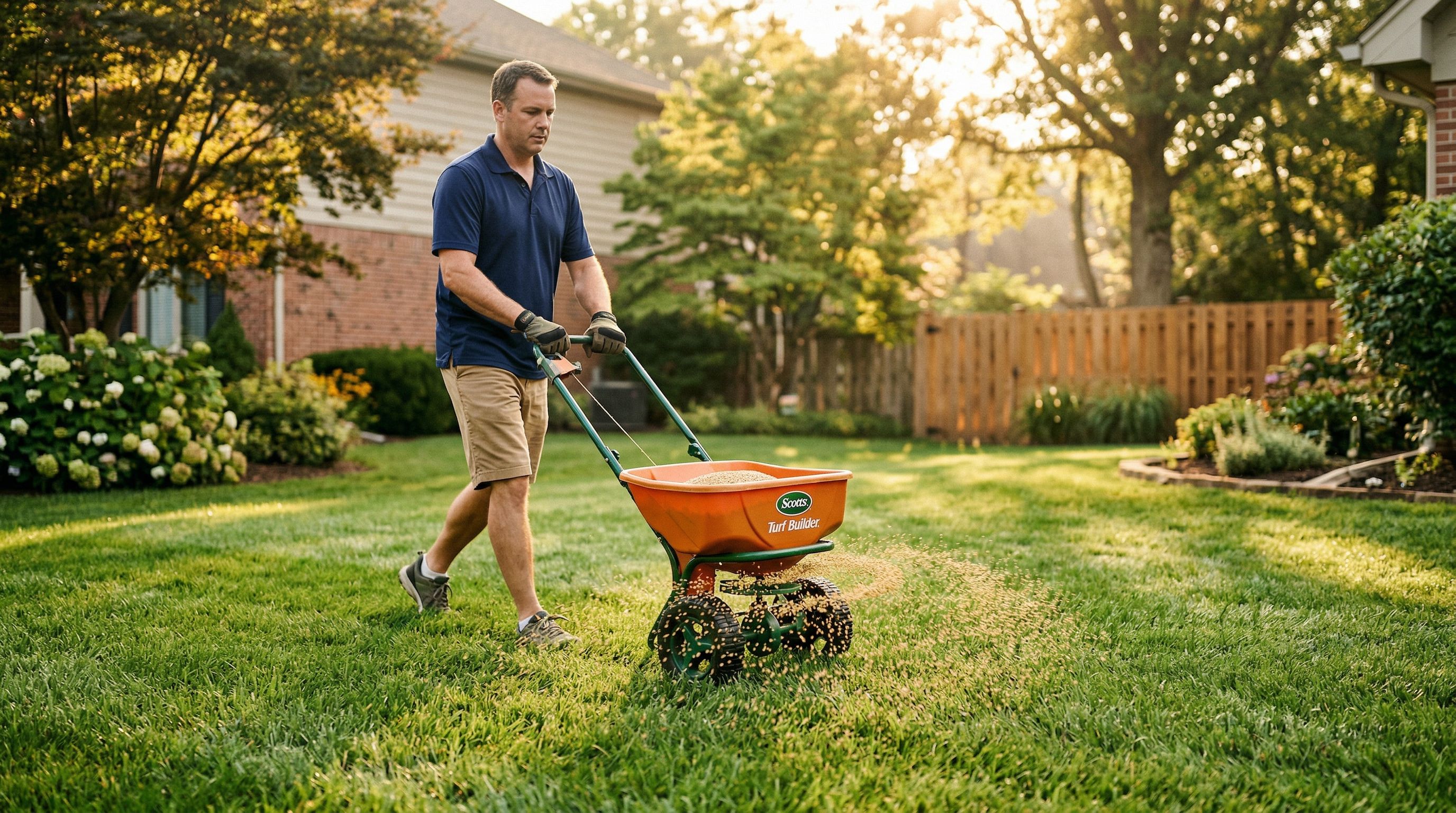
Use a broadcast (rotary) spreader for areas over 1,000 sq ft and a drop spreader for precision work along edges and garden beds. Check the fertilizer bag for specific settings for your spreader brand — Scotts products include settings for all major Scotts spreaders, and most other brands provide conversion charts.
For the most even coverage, apply at half the recommended rate in two perpendicular passes. Walk north-south for the first pass and east-west for the second. This eliminates the striping that can occur from a single pass and ensures you do not have hot spots or gaps.
Watering In
Water the fertilizer in lightly after application — a 10-15 minute irrigation cycle is sufficient. This dissolves the granules and moves the nutrients into the top layer of soil where seeds and roots are. Do not drench the area; you want to dissolve the fertilizer, not wash it away. If you are seeding at the same time, your normal seed-watering schedule (2-3 light waterings per day) will be enough to activate the fertilizer.
Warning
Never apply starter fertilizer to dry soil and leave it unwatered. Undissolved granules sitting on the surface can contact seedlings and cause fertilizer burn. Water within 24 hours of application.
Common Mistakes to Avoid
Using Weed-and-Feed on New Seed
This is the number one mistake we see. Weed-and-feed products contain pre-emergent or post-emergent herbicides that will kill your new grass seedlings just as effectively as they kill weeds. The pre-emergent component (usually prodiamine or dithiopyr) creates a chemical barrier that prevents any seed from germinating — including your grass seed.
Wait at least 6-8 weeks after new grass has established before applying any herbicide product. Ideally, wait until you have mowed the new grass 3-4 times. If weeds come up alongside your seedlings, pull them by hand or tolerate them temporarily. They will be crowded out once your grass fills in.
Over-Applying Fertilizer
More is not better with starter fertilizer. Applying at 2x the recommended rate will not make your grass grow 2x faster — it will burn the seedlings. High concentrations of salt in the fertilizer draw moisture out of the tender new roots through osmosis, killing them. Follow the bag rate exactly. If you are unsure, err on the side of less, not more.
Using High-Nitrogen Maintenance Fertilizer Instead
A 32-0-4 maintenance fertilizer has zero phosphorus — the exact nutrient your new seedlings need most. Using it as a substitute for starter fertilizer forces seedlings to develop roots with whatever phosphorus happens to be in your soil, which may not be enough. The high nitrogen also promotes rapid blade growth before roots are established, making the grass weak and prone to drought stress.
Applying Too Early or Too Late
Applying starter fertilizer weeks before seeding wastes much of the nitrogen through volatilization and leaching before the seedlings can use it. Applying weeks after germination means you missed the critical root development window. Keep it within a few days of seeding for best results.
Frequently Asked Questions
Can I use starter fertilizer on an established lawn?
You can, but it is not ideal. Established lawns need nitrogen more than phosphorus, and excess phosphorus can contribute to water pollution. In many jurisdictions, applying phosphorus to established lawns is prohibited. Stick to a maintenance fertilizer for established grass.
How long after applying starter fertilizer can I seed?
You can seed immediately — in fact, applying fertilizer and seed at the same time is the most common approach. Just make sure to water both in. There is no waiting period between starter fertilizer and seeding.
Do I need starter fertilizer if I did a soil test and phosphorus is adequate?
If your soil test shows phosphorus in the "adequate" or "high" range, you can skip the starter and just use a light nitrogen application. Many established lawns have accumulated sufficient phosphorus from years of fertilizer use. The soil test saves you money and avoids unnecessary phosphorus loading.
Scotts Starter vs The Andersons — which should I buy?
For most homeowners, Scotts Starter is the better value. It costs less, is available everywhere, and delivers strong results. The Andersons is worth the premium if you have poor soil (clay or sand) where the humic acid provides meaningful benefit, or if you are establishing a premium seed blend and want to maximize your investment. Both will produce noticeably better results than seeding with no fertilizer at all.
How soon after applying starter fertilizer should I see results?
You will not see the fertilizer's effect visually for the first 1-2 weeks — the initial benefit is all below ground in root development. By week 3-4, you should notice denser germination and slightly faster-growing seedlings compared to unfertilized areas. The biggest visible difference shows up at weeks 6-8 when fertilized grass is noticeably thicker and greener than unfertilized grass.
Related Guides