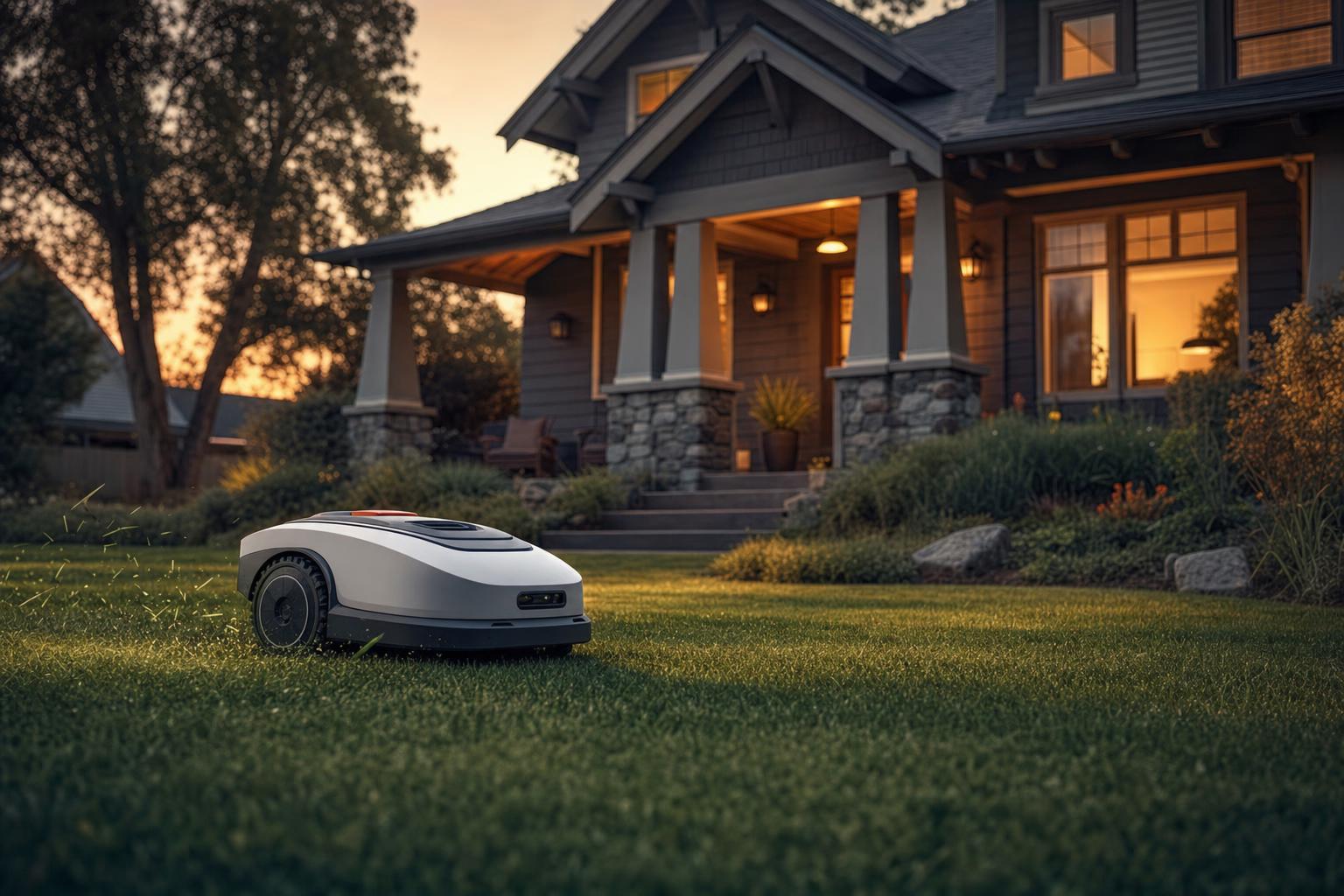
Best Robot Mowers for Mid-Size Yards 2026
Robot mowers can replace the weekly mow, but only when the lawn is ready for a robot. The mower is the easy part. The real buying decision is boundary wire, guide-wire routing, dock placement, slopes, dogs, sticks, theft exposure, and whether you are willing to debug a machine that gets confused at the same wet corner every Thursday.
TLDR
- Best overall, premium tier: Husqvarna Automower 430XH — 0.8 acre capacity, 45% slope handling, GPS theft tracking, and the least compromised boundary-wire platform here.
- Best budget / entry-level: Gardena Sileno City 250 — sub-3,000 sq ft lots, neighbor-friendly 57 dB, well under half the price of the Husqvarna.
- Best value if you like tinkering: Worx Landroid L (WR150) — 0.5 acre capacity, 35% slope rating, included boundary-wire kit, and a lower buy-in if you can tune the install yourself.
- Do not buy any of these expecting wire-free mowing: Husqvarna has GPS assistance and tracking, but the 430XH still needs boundary and guide wires. Worx WR150 and Gardena Sileno City do too.
Comparison table and full picks below. If you only read one other section, read the yard-fit matrix. It makes the hidden decision visible: robot mower regret usually comes from buying a machine for a lawn that needed grading, trimming, wire planning, or a walk-behind instead.
Pick by Yard Type, Not by Robot Hype
My robot-mower rule is simple: if you cannot draw the boundary loop and the return path in five minutes, the install is the product. The right robot is the one that fits your lawn's weird parts, not the one with the flashiest app screenshot.
| Your lawn | First pick | Why | What can go wrong |
|---|---|---|---|
| Tiny townhouse lawn, under 2,700 sq ft | Gardena Sileno City 250 | Quiet, small, and sized for a postage-stamp yard where a 0.5-acre robot is wasteful. | Disconnected front/back patches mean carrying the mower or planning a guide route. |
| 0.25-0.5 acre, budget-conscious, DIY owner | Worx Landroid L WR150 | Lower price than Husqvarna, included wire kit, and enough capacity for a normal suburban lot. | Slope-edge traction, outside-wire errors, dog fences, and paid add-ons can eat the savings. |
| 0.5-0.8 acre, slopes, narrow passages | Husqvarna Automower 430XH | More slope headroom, GPS theft tracking, guide-wire support, and dealer-install path. | Install cost and wire complexity can turn a $3k mower into a $4k project. |
| Front yard exposed to sidewalk/street | Husqvarna if you must; walk-behind if theft anxiety wins | PIN, alarm, geofence, and GPS tracking reduce risk but do not change visibility. | The mower spends hours outside unsupervised; a locked robot can still disappear. |
| Leafy, stick-heavy, rooty, wet low spots | Self-propelled mower or cleanup first | Robots like frequent, light grass cuts. They do not like debris fields. | Lifted, trapped, outside-wire, or blocked-dock errors become the real chore. |
Warning
If your yard has exposed roots, mulch islands, wet ruts, dog toys, extension cords, and a front strip by the street, do not buy a robot until you have a cleanup plan. A robot mower automates mowing; it does not automate judgment.
Robot Mowers Grew Up: What Changed in 2026
The first generation of consumer robot mowers (roughly 2010-2017) shared three big problems: they could not handle real slopes, they were dumb about weather, and they got lost in complex yards. The 2026 generation has solved all three.
Slope handling. The Husqvarna Automower 430XH climbs 45% grades. Worx WR150 and Gardena Sileno City both publish 35% work-area slope limits. The catch is boundary placement: manuals are more restrictive near boundary wires, because gravity can pull a robot outside the loop before it corrects. If the slope is at the edge of the lawn, not in the middle, treat the rating as a warning label rather than a promise.
Weather and growth logic. These are outdoor machines, and Husqvarna/Gardena/Worx all build around frequent light cutting. That does not mean wet mowing is free. Rain, soft soil, and leaves turn small routing mistakes into stuck errors. I would schedule around dry windows when the yard has slopes or shaded low spots.
Multi-zone and narrow passages. Robots can handle narrow corridors when the boundary and guide routing is good. They cannot solve truly disconnected lawns without either a mowable corridor, a guide-wire path, or you physically carrying the mower to a secondary area. Owner forums are full of people discovering that "front and back yard" is not one lawn if concrete, gates, or stairs split the route.
Perimeter wire vs GPS RTK. A few newer robots now offer wire-free setup using RTK, vision, or beacon systems. None of the three models in this guide are that. Husqvarna 430XH uses GPS assistance and GPS theft tracking, but it still needs boundary and guide wires. Worx WR150 is a boundary-wire mower with optional modules. Gardena Sileno City is a small boundary-wire mower with Bluetooth control.
Pro Tip
Robot mowers work best when they cut a tiny bit at a time, frequently. That is why they can make a maintained lawn look denser over time. They are a poor rescue tool for tall grass, debris, or a neglected renovation. If the lawn is thin, fix the turf first; then let the robot maintain it.
When a Robot Mower Is the Wrong Purchase
Three scenarios where a robot mower will disappoint, and you should buy a self-propelled walk-behind mower instead.
Lots Under 0.1 Acre
Even the smallest robot mower (Gardena Sileno City) costs around $900. For a 2,500 sq ft postage-stamp lot, the math never works — you would amortize the cost over decades. A $200 push mower or a $150 cordless mower mows that lot in 15 minutes. Skip the robot for very small yards.
Steep Slopes Over 30 Degrees
Even the Husqvarna 430XH's 45% work-area rating has a hard ceiling, and boundary-wire slope rules can be lower than the middle-of-lawn number. If your yard includes terraced areas, retaining-wall transitions, wet banks, or slopes beside a curb, the robot may get stuck or drift outside the wire. A self-propelled walk-behind, string trimmer, or slope redesign is more honest than hoping a robot will save a bad grade.
Leaf-Heavy Properties
Robot mowers are mowers, not leaf shredders. In fall, when oak and maple drop their leaves, robots get stuck on dense leaf piles or grind the blades dull faster. If your lot is surrounded by mature deciduous trees, you still need a fall leaf strategy (blower, bagger, or seasonal walk-behind mow). The robot covers grass-growing months; it does not eliminate fall yard work.
Warning
If most of what hits your lawn in spring/summer is leaves, sticks, and storm debris rather than grass clippings — your yard is not actually a lawn, it is a wooded area with grass. A robot mower will struggle. Reconsider what you actually need.
Top Picks: Comparison Table
Three robot mowers ranked by what actually matters: lot size capacity, slope handling, install complexity, app quality, theft protection, and price.
| Model | Coverage | Max Slope | Cut Width | Noise | Rating | Price |
|---|---|---|---|---|---|---|
| Husqvarna Automower 430XH | 0.8 ac | 45% | 9.5 in | 58 dB | 9.1/10 | $2,800 - $3,400 |
| Worx Landroid L (WR150) | 0.5 ac | 35% | 9 in | 63 dB | 8.3/10 | $1,300 - $1,700 |
| Gardena Sileno City 250 | 2,700 sf | 35% work area | 6.3 in | 57 dB | 8.5/10 | $900 - $1,200 |
Full specs in the tool catalog.
Best for Hills: Husqvarna Automower 430XH
The 430XH is the model I would trust first for a sloped robot-mower yard because Husqvarna publishes a 45% work-area rating and gives you a stronger install/support path than cheaper robots. That does not make it magic. The manual still has boundary-wire slope rules, obstacle offsets, and guide-wire planning; the robot is only as good as the route you give it.
At $2,800-3,400, the 430XH is a premium purchase. But if you have meaningful hills, complex corridors, or street-edge theft anxiety, the extra money buys more than acreage. You get GPS theft tracking, a mature dealer channel, and guide-wire support. The cheaper Worx can still be the right answer on a 0.25-0.5 acre yard if you are willing to tune wire placement yourself.
Husqvarna Automower 430XH Robotic Lawn Mower
Husqvarna
Owners of 1/4 to 0.8 acre lawns who want a hands-off, set-once-and-done mowing solution and don't mind premium pricing.
Best App Experience: Husqvarna Automower Connect / Worx Landroid
Husqvarna's Automower Connect app is the most mature in this group. Multi-zone scheduling, GPS theft tracking on premium models, and remote stop/start/send-home control are the features that matter. The app is not a substitute for wire planning, but it does make the mower easier to monitor when it is outside the kitchen window for hours.
The Worx Landroid app is the value-owner alternative. It gives you scheduling and setup without Husqvarna pricing, and the platform has optional modules such as Off Limits, Find My Landroid, and anti-collision accessories depending on region and availability. I would not buy those add-ons preemptively. Run the mower, find the actual failure mode, then decide whether the module is cheaper than moving wire.
Worx Landroid L 20V Robotic Lawn Mower (WR150)
Worx
Budget-conscious robot-mower buyers with 1/4 to 1/2 acre lots who can accept slightly rougher edges for half the price.
Best Budget / Entry-Level: Gardena Sileno City 250
At $900-1,200, the Sileno City 250 is the lowest-cost robot mower I would still put on a serious shortlist. It covers up to 2,700 sq ft (about 0.06 acres) — explicitly a townhouse, condo, or urban-yard target — and at 57 dB it is the quietest unit in this guide by a meaningful margin. Neighbors will not notice it running. For a first-time robot mower buyer who wants to test the category without committing $2,800 to the Husqvarna 430XH, the Sileno is the right entry point.
The catch is the coverage cap. If your lot is bigger than 0.06 acres, the Sileno City struggles to keep up — it spends most of its time charging. For larger yards in the 0.25-0.5 acre range, the Worx Landroid L is the next honest step up before the premium Husqvarna tier. But for the right small-lawn buyer, the Sileno is the rare budget pick that does not feel cheap.
Gardena Sileno City 250 Robotic Lawn Mower
Gardena
Townhouse, condo, and urban-yard owners with sub-3,000 sq ft lawns who prioritize quiet operation and neighbor-friendliness.
Installation Reality
The biggest hidden cost of a robot mower is the install. None of these are plug-and-play out of the box. Here is what to actually plan for.
Perimeter Wire Staking (2-6 hours)
Every model in this guide uses perimeter wire. You stake it around the lawn perimeter, around mulch beds, around pools or playsets, and around fixed obstacles the mower should avoid. Husqvarna professional install can bury boundary and guide wires, but a DIY install commonly starts with above-ground staking so you can test the route before committing.
Plan 2-3 hours for a small simple lawn (under 0.25 acres, one zone). Plan 4-8 hours for larger or multi-zone yards where you have to think through guide wires, narrow passages, obstacles, and the return path to the dock. If that sounds annoying, budget for professional installation before you compare robot prices.
Charging Dock Siting
The charging dock needs flat ground, outdoor power, and a clear approach path for the mower to find its way home. Most people put it in a discreet corner of the yard, behind a shed, or against the foundation in a side yard. Avoid spots that flood, collect leaves, sit beside a public sidewalk, or force the mower through a tight turn immediately after leaving the dock.
Neighbor Considerations
A 57-58 dB robot mower running at 7 AM on a Saturday is genuinely a non-issue for most neighbors. The 63 dB Worx Landroid L is more noticeable but still well below a gas mower. If you live in a tight neighborhood or shared-wall condo arrangement, schedule the robot for daytime hours and lean toward the quietest models (Sileno City or Automower 430XH).
Pro Tip
If installing a robot mower feels like more wiring work than you want to deal with, the alternative is a battery self-propelled mower. Zero install, same maintenance-free experience, but you still push the handle.
The Real Install Cost: Husqvarna vs Worx vs Gardena
The mower price is only the first line item. A robot mower also needs wire, stakes, connectors, blades, dock placement, and sometimes professional labor. Husqvarna can be the better ownership experience and still the worse ROI if the install turns into a full dealer project on a modest lawn.
| Model | Install style | Hidden cost to budget | Owner reality |
|---|---|---|---|
| Husqvarna 430XH | Boundary + guide wire; DIY or certified pro install | Install kit/wire, extra guide-wire planning, pro labor if buried | Best when complexity justifies the premium and you want dealer help. |
| Worx WR150 | DIY boundary wire with included kit | Extra wire/stakes, Off Limits or Find My module, traction fixes | Cheaper if you solve issues yourself; frustrating if you expected dealer polish. |
| Gardena Sileno City | Small-yard boundary wire + guide wire | Extra stakes/wire for obstacles; possible manual carry to secondary zones | Best when the lawn is tiny enough that the wire loop is simple. |
My buying threshold: if a professional install pushes the five-year cost above what you would spend on a good self-propelled mower plus your own time, the robot needs to solve a real problem: accessibility, slopes you hate mowing, neighborhood noise, or paid mowing replacement. If it is just a gadget, buy a better walk-behind.
Stuck, Outside-Wire, and Theft Reality
The owner reports worth listening to are not dramatic. They are repetitive: outside-wire errors on side slopes, guide-wire confusion in long narrow passages, wire breaks after edging or aeration, blocked charging stations, and lifted/trapped messages in wet low spots. That is the pattern across Automower and Landroid owner communities, and it lines up with what the manuals warn about.
This is where Husqvarna earns some premium. GPS theft tracking, guide-wire routing, dealer installation, and a mature support path reduce the time you spend debugging. Worx earns its value in the opposite direction: you pay less, accept more owner tuning, and use modules only when the yard proves it needs them. Gardena keeps the problem small by staying in small lawns.
Theft is similar. A PIN-locked robot is less useful to a thief, but a front-yard robot is still a visible object running unsupervised. I would be comfortable with a 430XH in a fenced or side/back yard. I would think twice about any robot repeatedly mowing a sidewalk strip beside a busy street unless the time savings were substantial.
Pro Tip
Before the first mow, walk the lawn and remove hose loops, dog toys, fallen sticks, solar lights, extension cords, and loose edging. Most early "bad mower" complaints are really "bad first week of site prep."
Frequently Asked Questions
How long do robot mower batteries last?
Plan for five-year ownership rather than forever ownership. Blades, wire repairs, dock wear, and eventual battery service are part of the bill. Exact battery timing depends on cycle count, heat, winter storage, and whether the manufacturer keeps replacement packs available.
Will it work in rain?
Yes, but I would not make wet mowing the goal. These are outdoor machines, and light rain is usually fine. The problem is wet traction: shaded low spots, muddy slopes, and leaf mats create the stuck errors that make owners hate robots.
Can my robot mower be stolen?
Yes. PIN locks, alarms, geofencing, and Husqvarna GPS tracking reduce the risk, but they do not make a street-edge mower invisible. If the mower will spend hours near a public sidewalk, theft anxiety belongs in the buying decision.
Will it cut my landscape lighting or sprinkler cables?
The mowing blades should not reach buried lighting or irrigation lines, but installation is where you can create problems. Map lighting, irrigation, invisible dog fence, and drainage routes before staking or burying the perimeter wire.
How loud are robot mowers?
Gardena Sileno City (57 dB) and Husqvarna 430XH (58 dB) are quieter than a normal conversation. Worx Landroid L is louder at about 63 dB in the current product data, but still dramatically quieter than a gas mower.
Perimeter wire or GPS RTK?
Every mower in this guide is boundary-wire based. Husqvarna GPS assistance and theft tracking do not remove the boundary/guide-wire job. Wire-free RTK or vision robots are a different category and should be compared separately.
How long does install take?
Small lawn: 2-3 hours of wire staking. Larger or multi-zone setups: 4-8 hours including dock siting, guide-wire planning, obstacle islands, and wire testing. Professional buried-wire installs cost more but can reduce exposed-wire damage.
What about steep slopes?
Husqvarna Automower 430XH handles 45% grades. Worx Landroid L and Gardena Sileno City both publish 35% work-area slope ratings, but boundary-wire slope rules can be more restrictive. If you cannot route the edge safely, buy a self-propelled walk-behind or fix the grade before buying a robot.
Source Notes
Robot mower copy gets sloppy fast because GPS, guide wire, RTK, and theft tracking all sound similar. These are the sources I used to keep the claims separated:
- Husqvarna 430XH support/specs and Husqvarna professional installation details for GPS theft tracking, 0.8 acre coverage, 45% slope rating, boundary/guide wire, and buried-wire install framing.
- Worx WR150 product page and Worx WR150 manual for the discontinued 1/2-acre model, 35% slope language, boundary wire, and outside-wire warnings.
- Gardena Sileno City 250 specs for 250 square meter coverage, 57 dB noise, Bluetooth control, and 35% slope language.
- Owner-community patterns were checked against Automower and Landroid discussions about outside-wire errors, guide-wire routing, slope edges, and wire breaks. I use those as failure-mode signals, not as controlled test data.
A robot mower needs a healthy lawn to start with
Robots cut tiny clippings and feed them back to the soil — but they cannot fix bare patches or thin turf. Start with the right seed for your region. Our sister publication, PremiumGrassSeeds.com, covers cultivar selection and overseeding strategy. Get the lawn to baseline density first, then let the robot maintain it.